The application deadline for this opportunity has passed. You can still review the details, but the listing is no longer presented as open for applications.
Fellowship
NSF Astronomy and Astrophysics Postdoctoral Fellowship
Offered by U.S. National Science Foundation
Location
United States
Funding
Fully Funded
Study level
Postdoctoral
Field of study
Physical Sciences
Application deadline
October 15, 2026
Application Closed
About This Fellowship
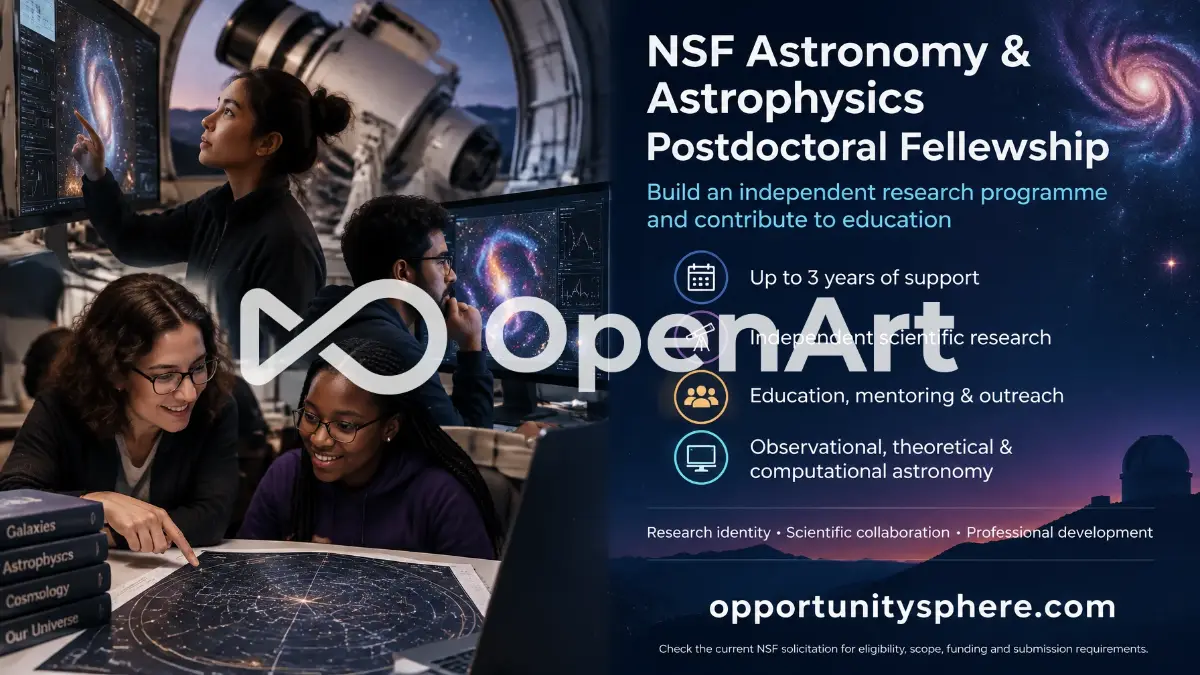
The NSF Astronomy and Astrophysics Postdoctoral Fellowship supports highly qualified early-career scientists who have completed, or are completing, doctoral-level training and are ready to develop an independent research programme in astronomy and astrophysics.
The fellowship is intended to provide more than a temporary continuation of doctoral research. It gives early-career scientists an opportunity to establish their own scientific direction, undertake original research and develop the professional experience needed for a longer-term career in astronomy, astrophysics or related scientific fields.
A particularly important feature of the programme is the combination of research and education. Fellows are expected to develop an independent scientific programme while also contributing to educational or broader scientific activities appropriate to the fellowship.
This combination reflects the wider role of researchers in the scientific community. In addition to producing new knowledge through research, early-career scientists may contribute through mentoring, teaching, public engagement, scientific communication, collaboration and other educational activities.
The fellowship is therefore intended for researchers who are ready to move toward greater scientific independence and who can articulate both a meaningful research agenda and a broader contribution to the astronomy and astrophysics community.
An Opportunity to Establish an Independent Scientific Identity
The postdoctoral period can be an important transition between doctoral research and a long-term scientific career.
During a PhD, researchers commonly work within a defined research group, laboratory, collaboration or supervisory structure. A postdoctoral fellowship can provide greater freedom to develop questions and approaches that reflect the researcher's own emerging scientific interests.
The NSF Astronomy and Astrophysics Postdoctoral Fellowship is designed around this stage of development.
Applicants should therefore think carefully about what they want their research programme to become.
Advertisement
🔒Application Closed
The listed deadline has passed. Check the official website to see whether the organisation has announced an extension or a new application period.
Stay in the loop
Your Next Opportunity Could Be One Email Away
Receive updates about scholarships, jobs, internships, fellowships and grants so you can discover opportunities worth exploring.
Stay Updated
Never miss an opportunity.
Get updates on scholarships, jobs, internships, grants, fellowships, conferences, and other opportunities delivered straight to your inbox.
The proposed work should demonstrate that the applicant has moved beyond simply completing a previous research project and is developing a research direction that can become part of their independent scientific profile.
This does not mean that the fellowship research must be completely unrelated to the applicant's doctoral work.
A researcher may build naturally on previous expertise while introducing a new scientific question, methodology, dataset, observational programme, theoretical framework, computational approach or interdisciplinary connection.
The important consideration is the development of an independent and coherent scientific programme.
Astronomy and Astrophysics Research
Astronomy and astrophysics encompass a broad range of scientific questions, from the study of individual astronomical objects to investigations of the origin, structure and evolution of the Universe.
Depending on the scope of the current NSF programme, applicants may work in areas connected with astronomical sciences and astrophysics, including observational, theoretical, computational and interdisciplinary research.
Potential research directions may involve subjects such as:
Stars and stellar evolution
Galaxies and galaxy formation
Cosmology
Exoplanets and planetary systems
High-energy astrophysics
Gravitational astrophysics
Solar and stellar physics
Interstellar and intergalactic processes
Computational astrophysics
Astronomical instrumentation
Observational astronomy
Theoretical astrophysics
Astroparticle-related research
Large astronomical datasets
Numerical modelling and simulation
Interdisciplinary astronomical research
The specific research scope should always be checked against the current NSF fellowship solicitation.
Applicants should not assume that every project involving astronomy automatically qualifies. The proposed research must fit the programme's current scientific scope and satisfy the applicable NSF requirements.
Research Programme: What Should It Accomplish?
The research proposal is one of the most important parts of the application.
Applicants should use the proposal to explain not only what they want to study but also why the research matters and how the proposed work will contribute to the field.
A strong research programme should establish a clear connection between the scientific question, the methods being proposed and the expected contribution.
Applicants should be able to explain:
The scientific question
What specific problem or question will the research investigate?
The current state of knowledge
What do researchers already know about the problem, and where are the important uncertainties or unanswered questions?
The research gap
What remains unresolved, and why is further investigation necessary?
The proposed approach
Will the project use observations, theoretical calculations, numerical simulations, computational methods, instrumentation, data analysis or a combination of approaches?
The expected contribution
What new understanding, evidence, methodology, dataset, model or scientific insight could result?
The applicant's role
Why is the applicant particularly prepared to undertake the proposed research?
The longer-term direction
How can the fellowship project contribute to the applicant's development as an independent scientist?
A proposal should make these connections clear rather than presenting a collection of interesting astronomical questions without a coherent research strategy.
From PhD Research to Independent Astronomy
For many applicants, the fellowship will represent the first major opportunity to establish a scientific programme that is clearly associated with their own developing research identity.
Applicants can use their doctoral research as a foundation while demonstrating how the proposed fellowship work will take their research in a meaningful new direction.
For example, a researcher may have developed expertise in analysing a particular class of astronomical data during doctoral study and now propose to apply that expertise to a new scientific problem.
Another researcher may have worked primarily on theoretical modelling and now wish to connect those models with observational data.
Others may develop computational approaches that allow previously difficult astronomical questions to be investigated using large datasets or advanced simulations.
The relationship between previous research and proposed work should be clear enough to demonstrate preparation but sufficiently developed to show future scientific independence.
Education as Part of the Fellowship
The fellowship is not exclusively about research.
An important component is the opportunity for fellows to contribute to education and mentoring.
For an early-career scientist, education-related activities can take many forms depending on the fellowship arrangements and research environment.
Possible activities may include:
Mentoring undergraduate students
Mentoring graduate students
Contributing to astronomy or astrophysics teaching
Developing educational materials
Supporting student research
Participating in scientific outreach
Communicating astronomical discoveries to broader audiences
Contributing to professional-development activities
Supporting educational programmes within the host environment
Applicants should review the current NSF solicitation for the specific expectations associated with education and broader activities.
The education component should also be connected to the applicant's professional goals.
For someone planning an academic career, for example, teaching and mentoring experience may form an important part of their development as a future faculty member.
For another researcher, public engagement or scientific communication may be a more appropriate way to contribute to astronomy education.
Research and Education Should Work Together
Applicants should avoid treating the research and education components as two completely unrelated parts of the application.
Where possible, the proposed activities should demonstrate how the fellow can contribute to the scientific and educational environment around them.
An astronomy researcher could, for example, connect their research expertise with student mentoring, computational training, observational activities or science communication.
The goal is not simply to list educational activities.
Applicants should explain what they intend to contribute, who may benefit and how the activities fit within their professional development.
The Research Environment
The environment in which a postdoctoral researcher works can have a significant influence on scientific development.
Applicants should therefore consider carefully where they would be able to conduct the proposed programme effectively.
The research environment may provide access to:
Research collaborators
Observational facilities
Astronomical datasets
Computing resources
Instrumentation
Specialist expertise
Seminars and scientific meetings
Graduate and postdoctoral researchers
Interdisciplinary research communities
Mentoring and professional-development opportunities
The ideal environment will depend on the applicant's research.
A computational astrophysics project may require substantial computing resources and relevant expertise, while an observational project may depend more heavily on access to particular facilities, instruments or datasets.
Applicants should demonstrate that the proposed research environment is appropriate for the programme they have designed.
Building a Professional Research Network
Postdoctoral fellowships can also provide an opportunity to establish relationships beyond the applicant's doctoral institution.
Astronomy is highly collaborative, with many research projects involving researchers from different institutions, countries and scientific specialisations.
A fellowship environment can therefore contribute to the development of professional networks through:
Research collaboration
Conferences and scientific meetings
Seminars
Working groups
Joint publications
Student mentoring
Interdisciplinary activities
International research relationships
These connections can remain valuable beyond the fellowship itself.
However, applicants should distinguish between collaboration and dependence.
The purpose of the fellowship is to support the development of an independent research programme. Collaborations should strengthen the project while allowing the applicant to demonstrate their own scientific contribution.
Who Is the Fellowship Intended For?
The programme is aimed at early-career scientists with doctoral-level research training who are prepared to pursue independent work in astronomy, astrophysics or related astronomical sciences.
It may be particularly relevant to researchers who:
Have recently completed doctoral research
Are completing their doctoral degree and meet the applicable NSF requirements
Have developed specialised expertise in astronomy or astrophysics
Want to establish an independent research direction
Are interested in observational or theoretical research
Work with computational or numerical methods
Conduct interdisciplinary astronomical research
Want to combine research with education or mentoring
Are preparing for longer-term research or academic careers
Applicants should not rely on this general description to determine eligibility. The current NSF solicitation contains the authoritative requirements.
Eligibility Considerations
Eligibility is governed by U.S. NSF rules and the specific requirements of the current Astronomy and Astrophysics Postdoctoral Fellowship solicitation.
Applicants should carefully verify matters such as:
Doctoral-degree requirements.
Timing of doctoral completion.
Career-stage requirements.
Citizenship or nationality provisions where applicable.
Institutional or host requirements.
Research-area eligibility.
Proposal requirements.
Any restrictions concerning previous fellowship support or appointments.
Submission requirements.
Because these conditions may be updated between funding cycles, applicants should consult the latest official NSF documentation before preparing a final application.
Funding and Research Support
Successful fellows receive postdoctoral fellowship support under the applicable NSF award arrangements.
The fellowship can provide financial support associated with the postdoctoral appointment and approved research activities.
Research support can be particularly important for astronomy and astrophysics because projects may involve expenses associated with data access, computational work, scientific travel, research collaboration or other approved activities.
The exact financial arrangements, allowable costs and research-support provisions are determined by the applicable NSF programme rules and award terms.
Applicants should therefore confirm current financial details directly from the official solicitation rather than relying on figures published for an earlier fellowship cycle.
Duration
The fellowship can provide support for up to three years, subject to the conditions of the applicable programme and award.
A multi-year fellowship can give researchers sufficient time to develop a research programme rather than attempting to complete an ambitious scientific agenda within only a short postdoctoral appointment.
Applicants should nevertheless ensure that the proposed research is realistic for the actual period of support available to them.
The research plan should distinguish between early-stage objectives and longer-term scientific goals.
For example, the first stage of a project may involve data preparation, observations or model development, followed by analysis and interpretation, and finally publication or dissemination of results.
The exact fellowship period should be confirmed from the current NSF solicitation.
What Applicants Should Prepare
The application package should be prepared according to the current NSF proposal requirements.
Depending on the applicable solicitation, applicants may need materials such as:
Research proposal
Curriculum vitae or biographical information
Academic and doctoral-degree information
Supporting statements
Education or mentoring plans where required
Host or research-environment information
References
Additional NSF-required documents
Other materials specified in the current solicitation
Applicants should not use an old checklist as their final guide.
NSF proposal requirements can change, and the current solicitation should always take priority over information from previous application cycles.
Developing the Education and Mentoring Component
Applicants should think carefully about what they can realistically contribute to education.
An effective education or mentoring plan should reflect the applicant's skills and interests rather than simply listing standard activities.
For example, an applicant with strong computational expertise may be able to contribute to student training in astronomical data analysis or scientific computing.
A researcher experienced in observational astronomy may be able to support student projects involving astronomical observations or data interpretation.
Another applicant may have experience communicating science to non-specialist audiences and could develop outreach activities around astronomical research.
The most useful plan will be specific about the intended audience and the nature of the proposed contribution.
Career Development During the Fellowship
A successful postdoctoral period can contribute to several dimensions of professional development.
Researchers may use the fellowship period to:
Strengthen publication records
Develop new research collaborations
Establish independent research themes
Gain experience mentoring students
Develop teaching experience
Present research at scientific meetings
Improve scientific communication
Learn new analytical or computational techniques
Develop grant-writing experience
Build an international research network
Prepare for future research or academic positions
Applicants should think about these goals before submitting the application.
A clear professional-development direction can help demonstrate why the fellowship is appropriate for the applicant's current career stage.
A Fellowship for Scientific Independence
The central theme of the opportunity is the development of independent scientific research.
Applicants should therefore avoid presenting themselves solely as assistants within another research programme.
Instead, the application should demonstrate that they have the expertise and scientific maturity to formulate meaningful research questions and lead the proposed work.
This does not mean that the researcher must work alone.
Astronomy is inherently collaborative, and successful research frequently involves large teams and international collaborations.
Independence refers to the applicant's scientific contribution and developing research identity, not the absence of collaboration.
Application Preparation Timeline
Applicants should begin preparing well before the submission deadline.
A practical preparation process can include:
Early planning
Read the current solicitation carefully and determine whether the programme matches your career stage and research area.
Research development
Define the scientific question and begin developing the research programme.
Research environment
Identify the environment, collaborators and resources needed for the proposed work.
Proposal development
Write and revise the research proposal well before the final submission period.
Education planning
Develop a realistic education, mentoring or broader scientific-engagement component where required.
Supporting documents
Prepare the CV, statements, references and other required materials.
Final compliance review
Check formatting, page limits, eligibility, submission requirements and all other instructions in the current NSF solicitation.
Submission
Submit through the appropriate NSF proposal system before the stated deadline.
Starting early is particularly important for fellowship applications because the research proposal may require substantial revision and feedback.
Questions Applicants Should Be Able to Answer
Before submitting, applicants should be able to explain:
What scientific problem am I addressing?
Why is this problem important?
What is currently unknown?
What will my research contribute?
Why am I well prepared to conduct this research?
What makes the proposed work appropriate for an independent research programme?
What resources or expertise will the research environment provide?
How will I contribute to education or mentoring?
How will this fellowship advance my scientific career?
What will I realistically accomplish during the fellowship period?
If these questions cannot be answered clearly, the proposal may need further development before submission.
Important Information Before Applying
The fellowship is intended for early-career researchers in astronomy, astrophysics and related astronomical sciences.
Applicants must satisfy the eligibility requirements established by the current NSF solicitation.
The proposed research must fall within the eligible programme scope.
The fellowship combines independent research development with education and broader scientific activities.
The fellowship may provide support for research and professional development, subject to NSF award conditions.
The fellowship can provide support for up to three years under the applicable programme conditions.
The exact financial arrangements should be confirmed from the current NSF solicitation.
Doctoral-degree and other eligibility requirements should be checked carefully.
Required application documents should be prepared according to current NSF proposal instructions.
Applicants should use the current NSF submission system and follow all applicable proposal requirements.
Programme rules, deadlines and application procedures may change between funding cycles.
Why Consider This Opportunity?
For an early-career astronomy or astrophysics researcher, the transition into independent research can determine the direction of a longer scientific career.
The NSF Astronomy and Astrophysics Postdoctoral Fellowship provides a framework in which researchers can develop their own scientific programme while gaining experience in education, mentoring and broader professional activities.
The opportunity is particularly relevant to researchers who already have a clear scientific direction and are ready to develop that direction beyond their doctoral work.
The fellowship can also provide time to establish collaborations, produce research outputs, expand technical expertise and prepare for future positions in academia or research.
Final Note for Applicants
The most important part of preparing for this fellowship is developing a research programme that is scientifically meaningful, clearly defined and appropriate for the applicant's stage of career development.
Applicants should begin by reviewing the latest NSF solicitation and confirming that they meet all applicable eligibility conditions.
They should then develop the research proposal, identify an appropriate research environment and prepare the education and professional-development components required by the programme.
Because NSF requirements, deadlines, funding arrangements and proposal instructions can change between application cycles, prospective applicants should rely on the current official NSF documentation when making final application decisions.
Related Opportunities
Explore other scholarships, fellowships, grants, research opportunities and more that may match your interests.