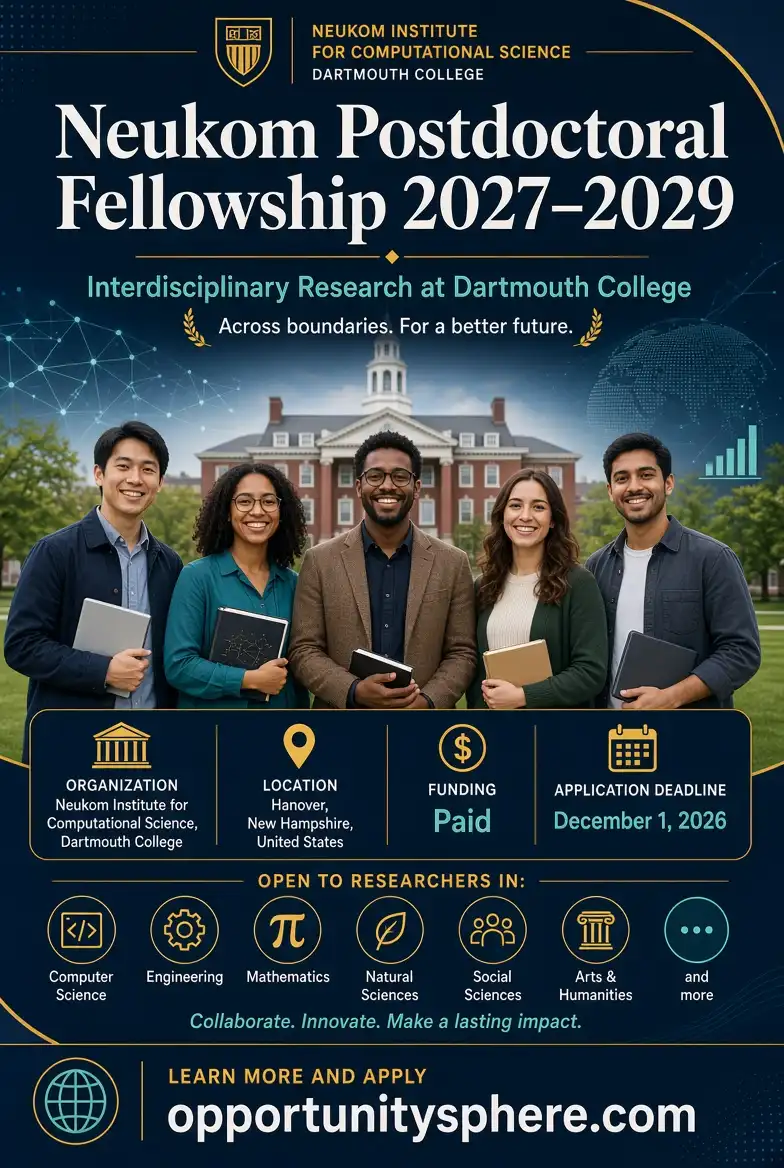
Neukom Postdoctoral Fellowship 2027–2029 — Interdisciplinary Research at Dartmouth College
Offered by Neukom Institute for Computational Science, Dartmouth College
Location
United States
Funding
Paid
Study level
Faculty & Academics, Postdoctoral, Researchers
Field of study
Economics, Life Sciences, Social Sciences, Natural Sciences, Computer Science & IT, Engineering, Mathematics & Statistics, Arts & Humanities, Environmental Sciences, Health & Medical Sciences, Physical Sciences, Other
Application deadline
December 1, 2026
About This Fellowship
The Neukom Postdoctoral Fellowship at Dartmouth College offers early-career scholars an opportunity to pursue interdisciplinary research that connects computation with other academic fields. Administered by the Neukom Institute for Computational Science, the programme supports researchers whose work crosses traditional disciplinary boundaries and demonstrates intellectual independence, collaborative ability and a willingness to explore new approaches to research.
Computation is increasingly important across academic disciplines. It can involve developing algorithms, analysing complex datasets, building mathematical models, simulating natural or social systems, examining digital cultures, or using computational methods to answer questions in the sciences, humanities and arts.
The Neukom Fellowship is designed for researchers who can use this broad computational perspective to connect different areas of knowledge. Applicants do not necessarily need to be computer scientists. Their work must, however, have a meaningful computational component, whether computation is a central research method or a framework for exploring an intellectual problem.
For example, a biologist might combine ecological field data with computational modelling to investigate ecosystem change. A social scientist could use data analysis to study patterns in human behaviour, while a humanities researcher might apply computational methods to historical texts or digital cultural materials. These examples illustrate the fellowship's interdisciplinary character; applicants must develop their own research projects and identify suitable Dartmouth faculty mentors.
The fellowship is expected to begin on September 1, 2027. Successful candidates will receive mentorship from faculty in at least two Dartmouth departments or programmes, establish their primary academic residence in one department and teach one seminar course each year.
The appointments last two years, with the option to request a third year. An extension is not automatic and depends on the programme's applicable arrangements.
Fellowship Funding and Benefits
1. Annual salary of US$70,000
The published salary for the 2027–2028 fellowship year is US$70,000. This is a paid postdoctoral research appointment rather than a tuition scholarship.
The salary is employment income and is subject to applicable taxes, deductions and Dartmouth employment policies.
2. Annual research support
The fellowship provides additional support for research-related expenses, including equipment, travel and research materials. The advertised 2027–2029 position information specifies an annual research stipend of US$5,000.
Applicants should confirm the precise spending rules and any approval requirements before budgeting for equipment, conference attendance or other research expenses.
3. Interdisciplinary faculty mentorship
Each fellow is mentored by faculty members in at least two Dartmouth departments or programmes. This arrangement is intended to help fellows develop research that benefits from multiple disciplinary perspectives.
Applicants should identify potential mentors whose expertise complements the proposed project and explain why collaboration across departments would strengthen their work.
4. Independent research development
Fellows have an opportunity to develop their own research interests while benefiting from an academic environment that supports computationally focused, cross-disciplinary work.
The programme is particularly relevant to scholars who want to build connections between their existing expertise and methods or questions from another field.
5. Teaching and academic development
Fellows teach one seminar course each year on a subject of their interest. This offers an opportunity to develop a course around their expertise and engage with students through research-informed teaching.
The fellowship does not list additional routine duties beyond its stated research, mentoring, residency and seminar-teaching expectations.
6. Potential third-year extension
The standard appointment is two years, with the option to request a third year. Applicants should treat the third year as a possibility rather than guaranteed funding or employment.
Eligibility Requirements
Academic qualification
Applicants must hold a PhD in any discipline, or expect to have the degree conferred by September 1, 2027.
Candidates with a Doctor of Musical Arts (DMA) or Master of Fine Arts (MFA) may also qualify under the programme's stated requirements.
Current Dartmouth postdoctoral researchers and fellows are eligible to apply, subject to the programme's rules.
Computational research connection
The proposed research interests or practice must intersect meaningfully with computation. This does not mean every applicant must develop new software or algorithms. Computational work can be an explicit research method or an important conceptual framework for investigating a question.
Applicants should explain precisely how computation contributes to their research rather than relying on a general claim that their work is interdisciplinary.
Interdisciplinary research experience
Candidates should demonstrate an interest in working across disciplines and show evidence of collaborative research, intellectual independence and initiative.
Relevant evidence may include interdisciplinary publications, collaborative projects, the use of methods from different fields, research outputs or work that connects previously separate areas of inquiry.
Willingness to think beyond traditional disciplinary boundaries
The fellowship seeks candidates who can approach research questions in new ways. Applicants should explain how their work challenges conventional boundaries, connects different perspectives or develops an original research direction.
Dartmouth faculty mentorship
Applicants are strongly encouraged to contact prospective faculty mentors while preparing their applications. Successful candidates must be able to establish a suitable mentoring arrangement across at least two departments or programmes.
A strong application should identify potential mentors and explain why their combined expertise is appropriate for the proposed research.
Residence and appointment commitment
Fellows are expected to reside at Dartmouth College in Hanover, New Hampshire, during the appointment, apart from approved or necessary travel for research and conferences.
Applicants should be prepared to teach one seminar course each year and participate in the academic environment associated with their appointment.
Who Should Apply?
The fellowship may be suitable for recent doctoral graduates whose research combines computational thinking with another discipline.
Potential applicants include:
Computer scientists and mathematicians developing computational methods, algorithms, simulations or models that address questions beyond their own fields.
Natural and life scientists using computational analysis to investigate biological systems, ecological patterns, physical processes or complex datasets.
Engineers integrating computational techniques with the design, analysis or evaluation of systems and technologies.
Social scientists and economists applying computational methods to human behaviour, social networks, institutions, markets or large-scale datasets.
Humanities researchers exploring digital texts, historical records, language, cultural materials or other research questions through computational approaches.
Researchers in arts and creative practice whose work meaningfully combines computation with creative inquiry or interdisciplinary scholarship.
Health and environmental researchers using computational modelling, data analysis or simulation to investigate complex problems.
A researcher whose primary background is outside computer science can still be a suitable candidate if computation plays a clear and substantial role in the proposed work.
For example, a scholar studying environmental change might combine ecological observations with computational modelling to investigate patterns that cannot be understood through field observations alone. The proposal would need to explain the computational contribution, identify appropriate Dartmouth mentors and show why collaboration across departments would improve the research.
How to Prepare a Strong Research Proposal
The fellowship's research statement must be no longer than two pages. It should communicate the proposed research clearly while demonstrating why it fits the Neukom Institute's interdisciplinary mission.
1. Define the research question
Identify a focused question that can guide the proposed work. Explain what you want to understand, why the question matters and what is currently unknown.
Avoid describing an entire research field without identifying a specific problem that the fellowship would help you investigate.
2. Explain the computational component
Describe the role of computation in the project. This might involve developing a model, analysing complex data, designing an algorithm, applying computational tools to existing material or using computation as a framework for theoretical inquiry.
Explain why the computational approach is suitable and what it will enable you to investigate.
3. Demonstrate interdisciplinary value
Identify the disciplines relevant to the project and explain what each contributes. A convincing interdisciplinary proposal does more than list departments: it shows how different perspectives or methods work together to address the research question.
4. Identify suitable Dartmouth mentors
Review the research interests and recent publications of potential faculty mentors. Consider how their expertise could complement your own and whether the project would benefit from collaboration across departments.
Applicants are encouraged to contact prospective mentors during preparation rather than waiting until the application is complete.
5. Show independence and feasibility
Explain what you would contribute personally and how the project develops your own research direction. Include a realistic account of the work you could undertake during the appointment and the outputs you hope to produce.
6. Connect the proposal to your research record
Use your CV and publications list to demonstrate that you have the necessary background to pursue the proposed work. If your previous research is mainly within one discipline, explain how your existing expertise prepares you to collaborate across fields.
Required Application Materials
1. Curriculum vitae
Provide an up-to-date academic CV covering your qualifications, research experience, publications, collaborations, teaching experience and relevant academic achievements.
2. Publications list
Upload your publications list separately from your CV, following the application instructions.
3. Research statement
Submit a statement of research interests of no more than two pages. Include a concise description of the research you would like to pursue as a Neukom Fellow and explain its computational and interdisciplinary dimensions.
4. Description of prospective departments and faculty
Identify the Dartmouth departments and faculty members with whom you would like to work. Explain why these connections are appropriate and how engagement with multiple departments would strengthen the project.
5. Three referees
Provide contact details for three referees whose recommendations can address your suitability for the fellowship. The application system contacts referees so they can submit their letters directly.
Applicants should contact referees in advance and make sure they understand the purpose of the fellowship and the recommendation deadline.
Optional materials:
One paper written in English, published or unpublished, or a comparable creative work.
A teaching statement.
A cover letter.
Optional materials should be included only when they strengthen the application and comply with the official instructions.
How to Apply
Step 1: Review the official announcement
Read the Neukom Institute's current postdoctoral fellowship announcement and confirm the eligibility requirements, appointment details and submission instructions.
Step 2: Identify your research direction
Develop a focused proposal that connects computation with another discipline. Be prepared to explain the research question, methods, originality and intended contribution.
Step 3: Find prospective Dartmouth mentors
Explore faculty and departmental research profiles. Contact suitable prospective mentors and discuss how their expertise could support your project.
Step 4: Prepare the written materials
Complete your CV, separate publications list, two-page research statement and description of the departments and faculty with whom you hope to work.
Step 5: Arrange your references
Select three referees who can provide informed assessments of your research ability, independence and interdisciplinary potential. Enter their contact information accurately in the application portal.
Step 6: Submit through Interfolio
Complete the online application using the official application link below. The application deadline is December 1, 2026.
Step 7: Confirm that recommendation letters arrive
Referees have until December 8, 2026, to submit their letters. Although the programme prefers applications to be complete by the main deadline, applicants should communicate with referees early and monitor the submission process.
Step 8: Prepare for the appointment
If selected, follow Dartmouth's instructions concerning appointment arrangements, residence, faculty mentorship and the annual seminar-teaching responsibility.
Important Dates
Application deadline: December 1, 2026.
Recommendation letter deadline: December 8, 2026.
Expected appointment start: September 1, 2027.
Standard appointment duration: Two years, with the option to request a third year.
The programme begins reviewing applications on December 1, 2026, and continues reviewing them until the positions are filled. Applicants should therefore submit a complete and carefully prepared application by the stated deadline.
Frequently Asked Questions
Is the Neukom Fellowship fully funded?
It is a paid postdoctoral appointment with a published annual salary of US$70,000 for 2027–2028. The programme also provides research-related support, including equipment, travel and research materials. The 2027–2029 position announcement specifies a US$5,000 annual research stipend.
Can researchers from outside the United States apply?
The programme announcement does not restrict eligibility to US citizens. International applicants should review Dartmouth's employment and immigration requirements and confirm any questions with the institute.
Must I have a PhD in computer science?
No. A PhD in any discipline may qualify, as can a qualifying DMA or MFA. However, the proposed research must have a meaningful computational component and demonstrate interdisciplinary potential.
Can my PhD be completed in 2027?
Yes. Applicants must have the qualifying degree by September 1, 2027.
Do I need to contact Dartmouth faculty before applying?
Applicants are strongly encouraged to contact prospective mentors while preparing their applications. Identifying appropriate faculty and explaining the intended collaboration can strengthen the proposal.
How many recommendation letters are required?
Three letters are required. Referees must submit them by December 8, 2026, which is seven days after the main application deadline.
Is the third year guaranteed?
No. The standard appointment lasts two years, with an option to request a third year. Applicants should not assume the extension will automatically be granted.
Must fellows live at Dartmouth?
Fellows are expected to be in residence at Dartmouth College, except for research and conference travel. Applicants should consider the practical implications of relocating to Hanover, New Hampshire.
Is teaching required?
Yes. Fellows teach one seminar course each year on a subject of their interest.
When does the fellowship begin?
The expected start date is September 1, 2027.
Related Opportunities
Explore other scholarships, fellowships, grants, research opportunities and more that may match your interests.