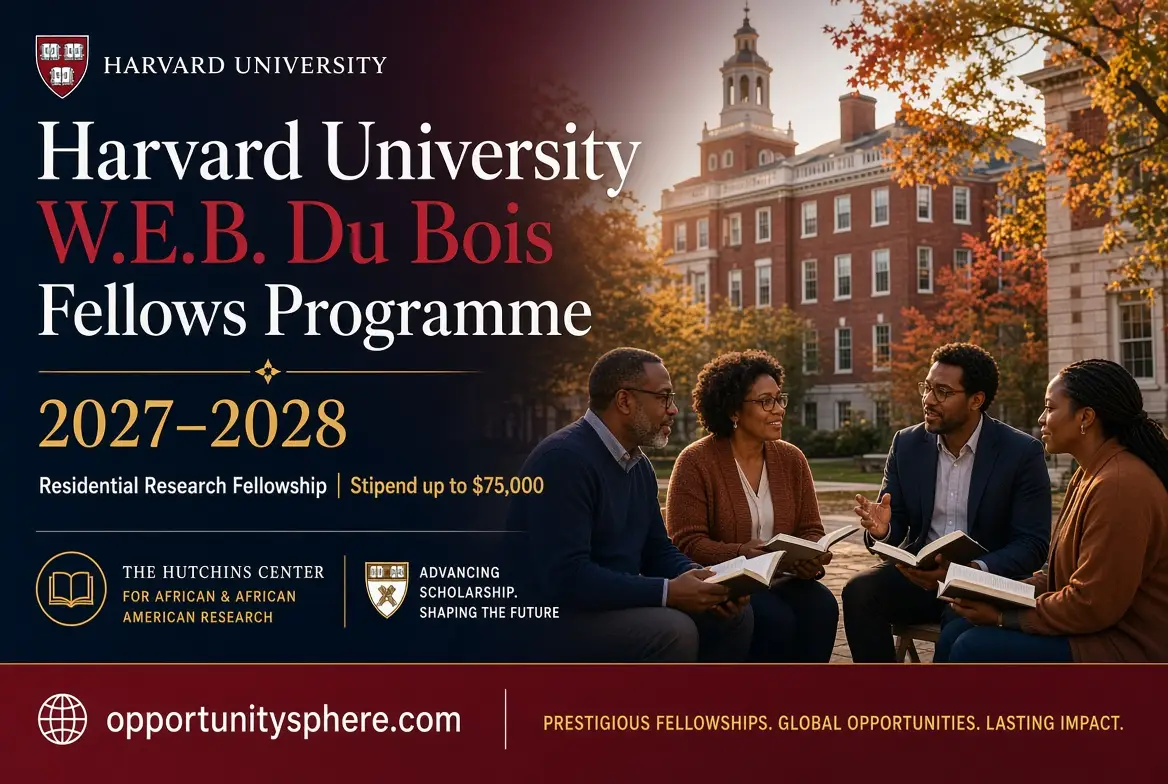
Harvard University W.E.B. Du Bois Fellows Programme 2027–2028 – Research Fellowship Worth Up to $75,000
Offered by Harvard University – Hutchins Center for African & African American Research (W.E.B. Du Bois Research Institute)
Location
United States
Funding
Fully Funded
Study level
Postdoctoral, Researchers, PhD
Field of study
Arts & Humanities, Social Sciences, Political Science
Application deadline
December 14, 2026
About This Fellowship
The W.E.B. Du Bois Fellows Programme 2027–2028, administered by the W.E.B. Du Bois Research Institute at Harvard University's Hutchins Center for African & African American Research, invites applications from accomplished scholars and creative practitioners whose work contributes to a deeper understanding of Africa, African Americans and the wider African Diaspora.
The programme is named after W.E.B. Du Bois, the influential African American sociologist, historian, civil rights activist and intellectual whose scholarship examined race, inequality, colonialism, education, political participation and the historical experiences of people of African descent. His work established important foundations for interdisciplinary research into the social, historical and political conditions affecting African and African-descended communities. The fellowship reflects this intellectual tradition by supporting research and creative work that examines these experiences from different academic and cultural perspectives.
For the 2027–2028 academic year, the programme offers scholars an opportunity to undertake a period of dedicated research in residence at Harvard University. Up to 20 fellows are appointed annually, bringing together researchers and creative practitioners whose projects address significant questions concerning African societies, African American experiences and the global African Diaspora.
Unlike conventional funding programmes that concentrate on one discipline or a narrowly defined research topic, the W.E.B. Du Bois Fellows Programme has a broad interdisciplinary orientation. It accommodates work in the arts, humanities and social sciences, provided that the proposed project has a meaningful intellectual connection to the Hutchins Center's research interests.
This creates opportunities for researchers examining subjects such as African political history, colonialism, slavery, migration, racial identity, social inequality, cultural production, education, literature, language, gender, intellectual history, political movements and the relationships between African societies and communities across the world.
The fellowship is particularly relevant to scholars whose work seeks to explain how historical experiences shape contemporary societies, how African and diaspora communities influence one another, and how cultural, political and social institutions develop across different geographical settings. Applicants may approach these questions through historical investigation, empirical social research, archival studies, comparative analysis, creative practice or interdisciplinary methodologies.
1. Research Areas and Projects Supported
The Hutchins Center provides an academic environment for examining African and African American experiences through historical, cultural, political, social and interdisciplinary perspectives. The programme's broad scope allows applicants to develop projects that address both established areas of scholarship and emerging questions affecting African and African-descended populations.
The following areas illustrate the types of research themes that may be relevant to the programme. They are indicative research areas rather than a fixed list of eligible degree subjects.
African history and historical studies
Research in African history may investigate the political, economic, social and cultural development of African societies across different historical periods. Relevant projects could examine precolonial political systems, traditional institutions, trade networks, religious transformations, colonial administration, resistance movements, independence struggles and postcolonial state formation.
Applicants may also explore how historical events continue to influence contemporary African institutions and social structures. For example, a project could investigate the long-term consequences of colonial land policies, the development of African intellectual movements, the influence of historical trade relationships on present-day economies or the role of oral histories in reconstructing events that are insufficiently represented in written archives.
Research may draw on archival documents, historical newspapers, government records, oral interviews, photographs, personal correspondence, institutional records and other primary sources. Projects that critically examine historical narratives, recover underrepresented experiences or reinterpret existing evidence can contribute to a broader understanding of African history.
African Diaspora, migration and transnational studies
The African Diaspora represents an important area of scholarship because the movement of African populations across continents has shaped societies, identities, political institutions and cultural traditions throughout the world.
Research in this area may examine the historical displacement of African populations through slavery, colonial labour systems and other forms of forced migration, as well as voluntary migration, contemporary mobility, transnational communities and the formation of diaspora identities.
Possible research questions include how African migrants maintain cultural and social relationships with their countries of origin, how diaspora communities influence political and economic developments in Africa, and how African cultural traditions are adapted in different geographical environments.
Applicants may also investigate the connections between African communities and populations in the Caribbean, Latin America, Europe and North America. Comparative projects examining identity, citizenship, race, belonging, cultural preservation and transnational political participation may be relevant where they establish a clear connection to the programme's research mission.
African American studies and race relations
The programme also supports scholarship examining the historical and contemporary experiences of African Americans and the wider structures that shape racial relations in the United States.
Relevant research may address slavery, emancipation, segregation, civil rights movements, racial discrimination, political participation, social mobility, education, community institutions and the continuing effects of historical inequality.
Applicants may investigate how race intersects with class, gender, citizenship, religion, economic opportunity and access to public institutions. Research could also explore the contribution of African American intellectuals, activists, writers, artists and political organisations to social transformation.
Comparative studies examining race relations in the United States alongside experiences in African countries or other diaspora societies may also be relevant, provided the project has a clear analytical purpose.
Literature, language and intellectual history
Literature and language provide important ways of understanding how African and African American communities represent their histories, negotiate identity and respond to social and political change.
Research may examine African literary traditions, African American literature, oral storytelling, indigenous languages, translation, publishing, intellectual movements, literary criticism and the development of cultural identities.
Applicants could investigate how writers use literature to challenge colonial narratives, how oral traditions preserve community histories, how language influences political identity or how African literary works engage with themes such as migration, conflict, gender, social inequality and cultural transformation.
Projects may also explore the work of influential African and African-descended intellectuals, the development of African literary institutions and the contribution of literature to debates about race, freedom, citizenship and social justice.
Arts, visual culture and creative research
The programme accommodates creative practitioners and projects that use artistic expression as a means of investigating African and African American experiences.
Potential areas include visual arts, photography, sculpture, film, performance, music, design, theatre, creative writing and other forms of cultural production.
Research may investigate how artists represent historical memory, political resistance, identity, migration, gender and social transformation. It may also examine the role of museums, cultural institutions, archives and creative communities in preserving or reinterpreting African heritage.
Applicants proposing creative projects should explain the intellectual or cultural questions informing their work. Their applications should demonstrate that the proposed creative output is not simply an artistic activity but contributes to a wider discussion relevant to the Hutchins Center's interests. An appropriate creative work sample should support the application.
Sociology, political science and social policy
Researchers in the social sciences may investigate the institutions, social relationships and political processes that influence African and African-descended communities.
Relevant subjects may include governance, citizenship, democracy, political participation, social movements, education, public policy, economic inequality, community development, gender relations, institutional accountability and access to public services.
For example, a researcher could examine the historical development of political participation among marginalised communities, the influence of education on social mobility, the role of community organisations in addressing inequality or the relationship between migration and changing patterns of identity.
Projects may use qualitative, quantitative or mixed-method approaches, including interviews, surveys, policy analysis, comparative studies and institutional research.
Gender, identity and social transformation
Research examining gender and identity can contribute to understanding how social institutions, cultural expectations, political structures and historical experiences shape the lives of African and African-descended populations.
Possible themes include women's participation in political movements, gender and labour relations, the representation of women in literature and the arts, gender-based inequality, family structures, identity formation and the experiences of marginalised communities.
Applicants may also investigate how gender intersects with race, class, religion, migration and citizenship. Projects should establish a clear connection to the wider intellectual concerns of African, African American or diaspora studies.
Interdisciplinary research
The fellowship's interdisciplinary orientation provides room for projects that bring different academic perspectives together to investigate complex research problems.
A project combining history and political science, for instance, could examine how colonial institutions influenced contemporary governance. Research integrating literature and sociology might investigate how creative works represent social inequality and identity. Similarly, a project connecting anthropology, migration studies and economics could examine how transnational communities maintain social and economic relationships across national boundaries.
The important consideration is that the disciplines should make a meaningful contribution to answering the research question. Merely mentioning several subjects does not automatically make a project interdisciplinary.
A proposed project does not necessarily need to focus exclusively on the United States or African American communities. Research involving African countries and other parts of the African Diaspora may be considered within the programme's broad academic scope. However, applicants must explain how their work contributes to the Hutchins Center's mission and the wider study of African and African-descended experiences.
2. What Fellows Gain from the Programme
The W.E.B. Du Bois Fellows Programme is designed to provide scholars with dedicated research time, financial support and access to an established academic environment. Its value lies not only in the monetary award but also in the opportunity to develop research while participating in an intellectual community with related academic interests.
Financial support and stipend
Selected fellows receive a stipend ranging from US$70,000 to US$75,000 for the ten-month academic year. The amount is adjusted for appointments lasting one semester rather than the full academic year.
This support is intended to enable fellows to concentrate on their scholarly or creative projects during their residential appointment. For researchers who might otherwise need to divide their time between research, teaching, administrative responsibilities and other professional commitments, the fellowship can provide an important period of dedicated work.
The stipend should nevertheless be considered alongside the practical costs of living in the United States. Applicants should investigate accommodation, transportation, personal expenses and other costs associated with spending an academic year in Cambridge, Massachusetts.
Research workspace and access to university resources
Fellows receive office space at the Hutchins Center, a Harvard email address and a university identification card that provides access to university resources.
The residential research environment can be particularly valuable for scholars working with extensive academic literature, historical documents, specialist collections and research materials. Harvard's wider academic environment also provides opportunities to encounter scholarship from different disciplines and engage with researchers working on related questions.
For example, a historian investigating African political movements may benefit from access to relevant historical literature and academic discussions, while a researcher examining migration or racial identity may find opportunities to engage with scholars working in sociology, history, law, politics and cultural studies.
The exact resources available for an individual project will depend on the nature of the research and applicable university access arrangements. Applicants should not assume that every specialised collection, database or research facility is automatically available without conditions.
Academic discussions and intellectual exchange
An important part of the programme is its structured academic engagement. Fellows are expected to participate in weekly colloquia and attend workshops, lectures and relevant social functions.
These activities provide opportunities to present research ideas, receive academic feedback, discuss methodological challenges and consider alternative interpretations of research findings.
A researcher developing a book manuscript, for instance, may benefit from discussing the organisation of the argument and the interpretation of evidence with scholars from related fields. Similarly, an early-stage creative project may benefit from conversations with researchers examining the historical and cultural questions informing the work.
The programme's intellectual activities also encourage interaction among fellows from different backgrounds and disciplines. This can help participants identify related research interests, develop academic relationships and gain perspectives that may strengthen their work.
Professional development and academic networking
A residential fellowship at Harvard can provide opportunities to establish professional relationships with scholars, researchers and creative practitioners. These interactions may support future academic discussions, collaborative research, conference participation and the development of scholarly networks.
The programme's value is therefore not limited to what a fellow completes during the appointment. The research conversations, professional relationships and academic exposure gained during the residency may also inform future publications, teaching, research projects and professional activities.
However, the fellowship should not be interpreted as a guaranteed route to a permanent academic appointment, employment at Harvard or future research funding.
Important financial consideration
The fellowship does not provide health insurance. International applicants should investigate suitable health coverage and understand the associated costs before accepting an appointment.
Applicants should also establish which relocation, travel, accommodation and personal expenses they will be responsible for. Although international fellows receive support with the visa application process through the Harvard International Office, this should not be confused with a promise that every immigration or relocation expense will be paid by the programme.
3. Who Can Apply?
The programme welcomes applicants of all nationalities and considers individuals at different stages of their academic or creative careers. International researchers, including eligible candidates from Nigeria and other African countries, may apply.
The selection process considers the applicant's achievements in relation to their career stage. This means that candidates are not necessarily expected to have identical academic records or professional experience. Rather, they should demonstrate that their previous work, intellectual development and proposed project establish them as suitable candidates for the fellowship.
The programme may be relevant to:
Established academics: University lecturers, professors and independent scholars seeking dedicated time to advance a significant research project, develop a manuscript or complete an important scholarly work.
Postdoctoral researchers: Researchers developing independent academic contributions after completing doctoral studies and seeking an environment in which to strengthen their research and professional profile.
African and African American studies researchers: Scholars whose work investigates African societies, African American experiences, diaspora communities, race, history, culture, politics or related fields.
Humanities and social science researchers: Academics working in history, sociology, anthropology, political science, literature, cultural studies, education and other relevant disciplines.
Creative practitioners: Writers, artists and other practitioners whose creative work addresses issues relevant to African, African American or African Diaspora studies.
Eligible doctoral researchers: Graduate students who satisfy the programme's specific institutional requirement.
Important restriction for doctoral students
Candidates applying in the graduate-student category must be enrolled in a doctoral programme at Harvard University. Doctoral students registered at other universities are not eligible to apply under this category.
This is a particularly important condition for international applicants. Although the fellowship welcomes scholars from different countries, that provision does not mean that every PhD candidate worldwide can apply as a graduate student.
Applicants who are not enrolled in a Harvard doctoral programme should assess whether they qualify under another appropriate career category, rather than assuming that their current doctoral registration makes them eligible.
English-language proficiency
Non-native English speakers must demonstrate English proficiency through TOEFL or IELTS scores or an audio-visual Zoom conversation with Hutchins Center administrators, in accordance with the programme's instructions.
Applicants should check the official guidance to establish which evidence is appropriate for their circumstances.
International applicants and immigration
International applicants are welcome. The Harvard International Office provides support with the visa application process for international scholars selected for the fellowship.
Applicants should understand that immigration support is not the same as automatic payment of visa fees, airfare, accommodation or relocation expenses. Candidates should make appropriate arrangements and obtain clarification about the applicable visa process before making travel plans.
4. What Makes a Competitive Fellowship Project?
The proposed project is central to the application because it gives the selection committee an opportunity to evaluate the applicant's intellectual direction, research ability and potential contribution to the programme.
A strong application should do more than identify an interesting subject. It should establish a specific research problem, explain why that problem matters, demonstrate familiarity with existing scholarship and show how the proposed work can make a meaningful contribution.
Applicants should approach the project description as a concise academic proposal rather than a general personal statement.
Identifying a significant research problem
The project should begin with a clearly defined problem or question. Applicants should explain the historical, social, political or cultural issue they intend to investigate and identify why it deserves further scholarly attention.
For example, rather than proposing a broad study of African migration, a candidate might investigate how a particular migration experience has influenced the formation of transnational identities within a defined community. A historian might examine how a specific colonial policy affected the development of an institution, while a literature researcher could investigate how selected African writers represent historical memory and displacement.
The more clearly the problem is defined, the easier it becomes to assess the project's purpose and feasibility.
Demonstrating knowledge of existing scholarship
Applicants should show that they understand the academic conversations surrounding their topic. This involves identifying relevant books, journal articles, historical debates and previous research.
A useful proposal explains what existing scholars have established, where their interpretations differ and what remains unresolved. The applicant should then identify how the proposed project will extend, challenge or refine existing knowledge.
A research gap should not be invented simply to make a project appear original. It should emerge from a careful assessment of the literature and available evidence.
Developing clear research objectives and questions
The proposal should state its overall aim and identify specific objectives that will guide the research.
Research questions should be focused enough to be investigated within the fellowship period. Applicants should avoid including too many unrelated questions, as this can make the project appear overly ambitious.
The objectives should connect logically to the research problem and methodology.
Explaining the methodology and research materials
Applicants should describe how they intend to investigate the problem and what evidence will be required.
Depending on the subject, appropriate approaches may include:
Archival investigation and historical document analysis.
Oral history interviews and examination of personal narratives.
Ethnographic fieldwork and community-based research.
Surveys, interviews and qualitative social research.
Quantitative analysis of relevant social or historical data.
Comparative studies across countries, institutions or communities.
Literary criticism, textual analysis and discourse analysis.
Visual analysis, creative practice and examination of cultural materials.
Candidates should explain why their chosen approach is suitable for answering the research questions. Where the project depends on specific archives, collections, participants or research materials, the applicant should identify them and consider whether they can realistically be accessed.
Establishing the original contribution
The proposal should explain what the completed research is expected to contribute.
This contribution may involve new empirical evidence, a reinterpretation of historical events, an improved understanding of social processes, a contribution to theoretical debates, a new methodological approach or a significant creative output.
Applicants should be specific about the intended contribution. Statements such as "the research will add to existing literature" are insufficient unless the proposal explains precisely what new understanding or evidence it expects to provide.
Explaining the relevance to the Hutchins Center
The connection between the proposed project and African, African American or African Diaspora studies must be clearly established.
For instance, a project on agricultural development in an African country should explain the historical, social, political or cultural questions that make it relevant to the programme. A study of migration should identify its relationship to African diaspora communities, identity or transnational experiences.
The geographical location of a study alone does not establish its relevance. Applicants should demonstrate the intellectual connection between the research question and the centre's academic interests.
Showing what can be achieved during the residency
The fellowship is a time-limited residential appointment. Applicants should explain what they intend to accomplish during their stay and how the period of dedicated research will advance the project.
Possible objectives may include completing archival analysis, developing a book manuscript, preparing journal articles, producing a substantial creative work, analysing research data or completing an important stage of an ongoing project.
Candidates should set realistic goals rather than promising an entire research programme that cannot reasonably be completed during the appointment.
5. Application Requirements
Applications are submitted through Harvard's SlideRoom platform. Candidates should prepare their materials carefully because the selection committee uses the submitted documents to assess the applicant's background, previous achievements and proposed work.
The university specifies the following principal application materials:
1. Five-page project description
Applicants must submit a project description of five pages, double-spaced. The bibliography is excluded from the five-page limit.
This document should explain the proposed research or creative project, its background, central questions, methodology, significance and expected contribution.
The proposal should be sufficiently detailed to demonstrate intellectual preparation without becoming unnecessarily broad. Applicants should use the available space to communicate a coherent argument and avoid filling it with general statements about their interest in the subject.
A useful structure is to introduce the research problem, discuss the relevant literature, establish the objectives, explain the methodology, identify the expected contribution and demonstrate the project's connection to the Hutchins Center.
2. Curriculum vitae
Applicants must provide an up-to-date CV that presents their academic, professional and creative achievements.
Depending on their career stage and discipline, relevant information may include:
Academic qualifications and institutions attended.
Research appointments and professional experience.
Peer-reviewed journal publications and books.
Conference papers and academic presentations.
Research grants, fellowships and awards.
Teaching and supervision experience.
Relevant professional memberships.
Creative works, exhibitions, performances or other outputs.
Applicants should prioritise achievements relevant to the proposed project. A CV should make it easy for the selection committee to understand the candidate's research development and professional contributions.
3. Scholarly or creative work sample
Applicants must submit an approximately 20-page scholarly work sample or an appropriate creative sample.
The work sample is important because it provides evidence of the applicant's ability to produce high-quality academic or creative work. It should demonstrate the quality of their analysis, writing, interpretation, research methods or artistic practice.
For an academic researcher, an appropriate sample might be an extract from a thesis, a published article, a book chapter or another substantial scholarly work. Creative applicants should provide a sample that represents their strongest relevant output and follows the platform's instructions.
Candidates should select material that reflects the intellectual quality and subject expertise demonstrated in their proposed project.
4. Three recommendation letters
Applicants must arrange three recommendation letters.
These should come from referees who are sufficiently familiar with the candidate's academic ability, research contributions, professional development or creative work to provide meaningful assessments.
Where possible, applicants should approach senior academics, research supervisors, collaborators or other appropriate professionals who can discuss the quality of their work with specific examples.
A strong recommendation should provide more than a general statement that the candidate is hardworking. It should offer informed evidence of the applicant's research ability, intellectual independence, professional achievements and suitability for the proposed fellowship.
Applicants should contact referees early, provide them with the fellowship guidelines and share their project description and updated CV. This gives referees enough time and information to prepare useful recommendations.
5. English-language proficiency evidence
Non-native English speakers must satisfy the programme's English-proficiency requirements through TOEFL or IELTS scores or an audio-visual Zoom conversation with Hutchins Center administrators.
Applicants should consult the official application instructions to determine the appropriate route for their circumstances.
6. How to Prepare and Submit an Application
The application is completed online through the Harvard SlideRoom platform. Candidates should approach the process in stages to avoid submitting incomplete or poorly coordinated materials.
Step One: Confirm eligibility and career category.
Read the official fellowship guidelines and establish whether your academic or creative background meets the programme's requirements.
Doctoral students should pay particular attention to the Harvard enrolment restriction. Applicants should also determine whether their proposed research has a sufficiently clear connection to African, African American or African Diaspora studies.
Step Two: Develop a focused project.
Identify a specific research problem and prepare a project description that explains the background, research questions, methodology, contribution and expected outcomes.
Candidates should ensure that the project is achievable during the proposed residential period and that the work will benefit from the academic environment offered by the Hutchins Center.
Step Three: Prepare the CV and work sample.
Update your academic CV and select a scholarly or creative sample that demonstrates your ability to undertake the proposed work.
The work sample should be carefully chosen rather than submitted simply because it is the most recent document available. It should reflect your strongest relevant research or creative achievement.
Step Four: Arrange the recommendation letters.
Contact three suitable referees before beginning the final submission process. Explain the fellowship opportunity, provide the necessary documents and confirm that they understand the separate recommendation deadline.
Applicants should monitor the application platform and ensure that their referees submit their letters on time.
Step Five: Complete the online application.
Create or sign in to a SlideRoom account and complete the application using the instructions provided. Upload the project description, CV and work sample in the designated sections.
Check the documents for formatting, page limits, completeness and consistency before submitting.
Step Six: Submit and monitor communications.
Submit the main application by the stated deadline and retain confirmation of submission. Continue to monitor your email for updates or requests from the Hutchins Center.
There is no application fee for this fellowship.
For questions about the programme or application process, applicants can contact Dr. Lori De Lucia at loridelucia@fas.harvard.edu.
7. Important Application Dates
Application requirement
Deadline
Main fellowship application
14 December 2026
Three recommendation letters
21 December 2026
Fellowship period
2027–2028 academic year
The main application must be submitted by 14 December 2026. Recommendation letters have a separate deadline of 21 December 2026.
Applicants should not wait until the final days to prepare their project descriptions or contact referees. The quality of the research proposal and the time needed to coordinate supporting documents make early preparation particularly important.
8. Practical Considerations for International Applicants
Although the programme accepts applications from different nationalities, international applicants should consider several practical issues before applying.
Career-category eligibility: International doctoral students enrolled outside Harvard should not assume they qualify under the graduate-student category. The specific Harvard enrolment condition must be respected.
Research relevance: Applicants working on African subjects should explain the connection between their research and the wider intellectual interests of the Hutchins Center. A project does not become automatically suitable merely because its geographical focus is an African country.
Research preparation: Candidates should prepare a strong academic or creative work sample that demonstrates their ability to carry out the proposed project. Researchers who have published journal articles, book chapters or other substantial work should consider selecting a sample that best illustrates their research strengths.
Financial planning: The stipend is substantial, but health insurance is not included. Applicants should also investigate accommodation, travel, living expenses and other costs associated with the residential appointment.
Visa arrangements: Harvard provides immigration-process support through its International Office for international fellows. Candidates should follow the university's instructions and avoid making travel or relocation arrangements before receiving the necessary guidance.
Residential participation: The fellowship involves more than receiving funding to conduct independent research remotely. Fellows are expected to participate in the programme's academic activities and engage with the Hutchins Center's research community.
9. Why This Fellowship Is Worth Considering
The W.E.B. Du Bois Fellows Programme offers a distinctive opportunity for researchers and creative practitioners whose work contributes to understanding Africa, African Americans and the global African Diaspora.
Its significance lies in the combination of substantial financial support, a dedicated residential research period and access to an academic community that encourages intellectual exchange across disciplines. Rather than supporting only one narrowly defined research area, the programme brings together scholars investigating different aspects of African and African-descended experiences.
For African researchers, the fellowship can provide an opportunity to develop scholarship that places African histories, institutions, cultures and contemporary experiences within wider global discussions. A historian may use the residency to deepen archival research, a sociologist may refine an investigation into inequality and identity, while a literary scholar may develop a manuscript examining African literary traditions and their relationship with diaspora experiences.
Creative practitioners can also use the opportunity to develop work that engages with questions of historical memory, cultural identity, representation and social transformation.
The fellowship may be particularly valuable to scholars working on research that requires sustained writing, critical reflection and engagement with academic literature. A period of dedicated research can help move a project from preliminary investigation towards a completed manuscript, substantial publication or other significant scholarly output.
However, the programme is competitive, and the availability of up to 20 fellowships annually should not be interpreted as a guarantee of selection. Applicants need to demonstrate a strong record of achievement appropriate to their career stage, a clearly defined and relevant project, and the ability to make meaningful use of the residential appointment.
Ultimately, the strongest applications will explain three things convincingly: why the proposed research matters, why the applicant is qualified to undertake it, and why the W.E.B. Du Bois Research Institute at Harvard is an appropriate environment in which to develop the work.
Applicants should review the official guidelines carefully, confirm their eligibility category and prepare all supporting documents before submitting their applications.
Related Opportunities
Explore other scholarships, fellowships, grants, research opportunities and more that may match your interests.