Hamilton Shirley Amerasinghe Memorial Fellowship Programme 2026
Offered by United Nations Division for Ocean Affairs and the Law of the Sea
Location
International / United Nations
Funding
Fully Funded
Study level
Postdoctoral, Professional
Field of study
Political Science, Law, Environmental Sciences
Application deadline
October 25, 2026
About This Fellowship
1. Program Overview and Historical Background
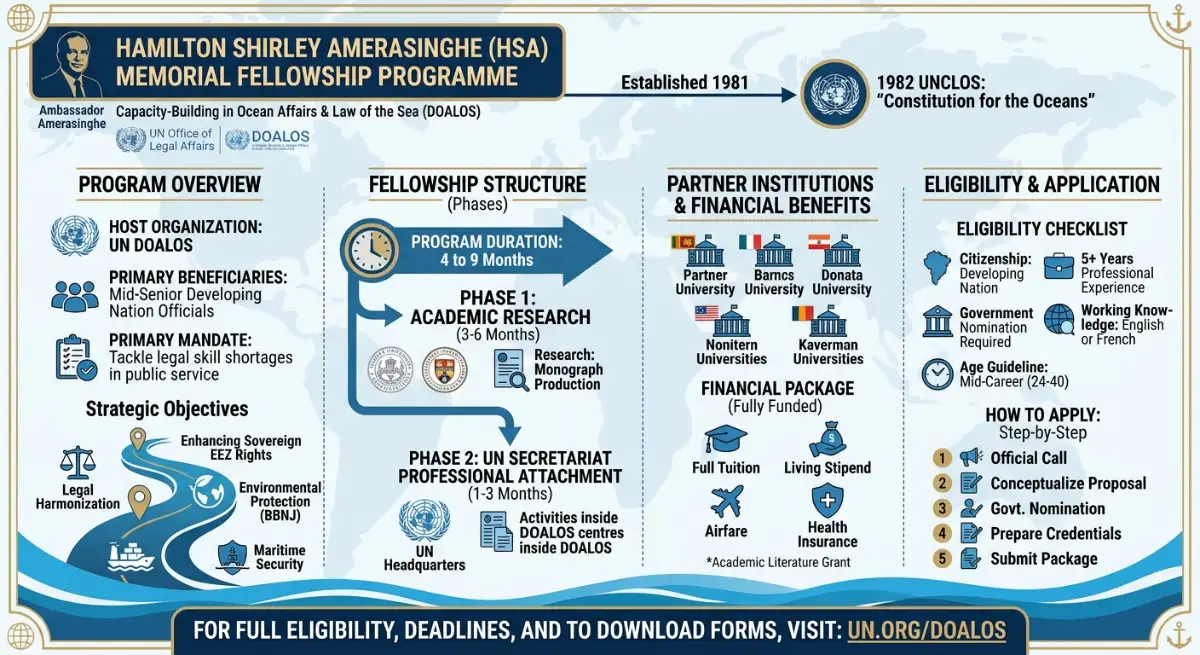
The Hamilton Shirley Amerasinghe (HSA) Memorial Fellowship Programme is a flagship international capacity-building initiative administered by the Division for Ocean Affairs and the Law of the Sea (DOALOS) within the United Nations Office of Legal Affairs.
Established in 1981 by the UN General Assembly under Resolutions 35/116 and 36/79, the fellowship honors the legacy of Hamilton Shirley Amerasinghe, former President of the Third United Nations Conference on the Law of the Sea (UNCLOS III). Ambassador Amerasinghe was instrumental in guiding the complex negotiations that ultimately yielded the 1982 United Nations Convention on the Law of the Sea (UNCLOS), widely recognized as the foundational "Constitution for the Oceans."
The primary mandate of the HSA Fellowship is to address critical institutional and legal skill shortages across developing nations. By funding advanced postgraduate research and offering operational placements inside the United Nations Secretariat, the program equips diplomats, government legal counsel, policy advisors, and marine scientists with the legal mastery required to effectively govern national maritime domains.
2. Summary Table of Key Features
Program Parameter
Official Specification
Host Organization
UN Division for Ocean Affairs and the Law of the Sea (DOALOS)
Primary Beneficiaries
Mid to Senior-Level Public Servants from Developing Nations
Program Duration
4 to 9 Months (Combined Academic Study + UN Internship)
Financial Package
Fully Funded (100% Tuition, Monthly Living Stipend, Flights, Health Insurance)
Academic Locations
Partner Universities in USA, UK, Canada, Germany, Netherlands, Malta
UN Location
United Nations Headquarters, New York City, USA
Language Requirements
Spoken and Written Proficiency in English or French
Nomination Requirement
Official Government Endorsement from Sponsoring Ministry/Agency
The fellowship focuses on strengthening state capacity to handle ocean governance challenges, negotiate international maritime legal agreements, and enforce maritime domain awareness. Key objectives include:
Legal Harmonization: Assisting developing countries in aligning domestic statutory frameworks with the rules of UNCLOS and related international instruments.
Sovereign EEZ Rights: Enhancing national capacity to manage Exclusive Economic Zones (EEZs), seabed mineral exploration, continental shelf extensions, and offshore renewable energy installations.
Environmental Protection: Building expertise in international treaties governing marine pollution, climate change impact, ocean acidification, and the Conservation and Sustainable Use of Marine Biological Diversity of Areas Beyond National Jurisdiction (BBNJ Agreement).
Maritime Security & Border Delimitation: Providing practical training on maritime boundary negotiations, freedom of navigation, port State measures, and curbing Illegal, Unreported, and Unregulated (IUU) fishing.
4. Fellowship Structure and Program Phases
The HSA Fellowship uses a dual-component model that pairs rigorous academic scholarship with real-world diplomatic training at UN Headquarters.
+------------------------------------------------------------------+
| PHASE 1: Advanced Academic Research & Coursework (3 to 6 Months) |
| Placed at a leading international partner university or institute|
+------------------------------------------------------------------+
|
v
+------------------------------------------------------------------+
| PHASE 2: UN Secretariat Internship Attachment (1 to 3 Months) |
| Stationed at UN Headquarters (DOALOS Office) in New York City |
+------------------------------------------------------------------+
Phase 1: Academic Research & Advanced Coursework (3–6 Months)
Fellows spend three to six months in residence at an approved university or marine legal institute. During this term, fellows:
Carry out supervised research on an approved ocean policy or law topic directly aligned with their home government's strategic priorities.
Participate in specialized graduate seminars on UNCLOS, maritime boundary delimitation, environmental law, and international dispute settlement.
Produce a publishable research monograph under the direct guidance of world-class academic specialists.
Phase 2: Secretariat Professional Attachment (1–3 Months)
Following the academic term, fellows transition to United Nations Headquarters in New York City.
During this professional attachment inside DOALOS, fellows:
Observe intergovernmental deliberations, including meetings of the UN General Assembly and the Informal Consultative Process on Oceans and the Law of the Sea.
Assist UN legal officers with analytical assignments, legislative reviews, and briefing preparation.
Gain firsthand exposure to international diplomatic negotiations, treaty depositary workflows, and multilateral consensus-building.
5. Participating Host Universities and Institutions
Placements are arranged by DOALOS based on the fellow's research proposal and language profile. Renowned partner institutions include:
Center for Oceans Law and Policy, University of Virginia (United States)
Marine and Environmental Law Institute, Dalhousie University (Canada)
Max Planck Institute for Comparative Public Law and International Law (Germany)
Netherlands Institute for the Law of the Sea (NILOS), Utrecht University (Netherlands)
IMO International Maritime Law Institute (IMLI) (Malta)
School of Law, University of Rhode Island (United States)
6. Detailed Eligibility Requirements and Prerequisites
Applicants must fulfill all eligibility criteria to be considered by the selection board:
Citizenship: Must hold nationality from a recognized developing country (as categorized by the United Nations General Assembly).
Professional Experience: Must possess at least 5 years of professional experience in ocean affairs, law of the sea, marine environmental policy, fisheries regulation, or maritime border enforcement.
Current Employment: Must be an active employee within a government ministry, state legal agency, foreign service department, or public research institution dealing with marine affairs.
Academic Credentials: Minimum of a Bachelor’s degree in Law, International Relations, Political Science, Marine Biology, Environmental Management, or related public policy fields (Master's or LL.M. preferred).
Age Guidelines: Targeted primarily at mid-career public servants, generally between 24 and 40 years of age.
Government Nomination: Mandatory formal nomination and endorsement by an authorized government official (e.g., Permanent Mission to the UN, Ministry of Foreign Affairs, or Ministry of Justice).
Language Mastery: Excellent working knowledge of English or French.
7. Financial Benefits and Award Coverage
The HSA Fellowship is a fully funded award covering all logistical, academic, and personal living expenses:
Full Tuition Coverage: Direct payment of university tuition, registration fees, administrative charges, and laboratory access costs.
Monthly Living Allowance: Standard UN living stipend calculated to comfortably cover accommodation, meals, transport, and daily living expenses in host cities and New York City.
International Travel: Full economy-class round-trip airfare connecting the fellow's origin country, host academic institution, UN Headquarters, and return travel.
Comprehensive Health Insurance: Enrollment in standard UN health and accident coverage for the complete duration of both program phases.
Academic Literature Grant: A fixed book and software allowance to support literature purchases and technical research tools.
8. How to Write a Competitive Research Proposal
The research proposal forms the core component of the application dossier. Candidates must demonstrate how their project addresses an urgent legal, regulatory, or policy gap in their home country.
High-Priority Research Topics:
Implementing the BBNJ Agreement: Formulating domestic regulatory tools for marine genetic resources and environmental impact assessments on the high seas.
Continental Shelf Claims: Legal and bathymetric preparation for submissions to the Commission on the Limits of the Continental Shelf (CLCS).
Climate Change and Baseline Rights: Legal stability of coastal baselines and maritime entitlements in the face of sea-level rise.
Sustainable Blue Economy Governance: Creating investment frameworks for offshore wind energy, deep-sea conservation, and eco-friendly aquaculture.
IUU Fishing Control: Enforcing the Agreement on Port State Measures and regional fisheries management conventions.
Structure of an Effective 3-to-5 Page Proposal:
Title & Abstract: Concise title and a 200-word overview of the central problem.
Statement of the Problem: Clear narrative explaining the practical governance or legal difficulty facing the candidate's country.
Research Objectives & Legal Questions: Core questions regarding UNCLOS or regional treaties that the study will resolve.
Methodology: Treaty provisions, statutory laws, judicial precedents, and policy frameworks to be evaluated.
National Policy Application: Specific outline of how the research findings will be used by the sponsoring ministry upon the fellow's return.
9. Step-by-Step Application Instructions
Step 1: Review Official Call for Applications: Visit the UN DOALOS official website to verify annual opening dates, instructions, and active research priority areas.
Step 2: Conceptualize and Draft Proposal: Write a clear 3 to 5-page research proposal aligned with UNCLOS principles.
Step 3: Obtain Official Government Nomination: Request formal endorsement and signature on the official UN Nomination Form from your ministry head, Permanent Mission, or Foreign Affairs directorate.
Step 4: Prepare Supporting Academic Credentials: Collect certified copies of university diplomas, transcripts, English/French proficiency proof, and updated professional CV.
Step 5: Submit Complete Package: Send the entire application dossier electronically to the DOALOS Fellowship Secretariat prior to the stated deadline.
10. Required Document Checklist
UN Fellowship Application Form: Fully completed and signed by the candidate.
Official Government Nomination Form: Stamped and signed by the nominating authority.
3–5 Page Research Proposal: Structured according to DOALOS guidelines.
Detailed Curriculum Vitae (CV): Documenting 5+ years of relevant public sector experience.
Certified Academic Degrees & Transcripts: With official translations into English or French if original documents are in another language.
Proof of Language Proficiency: Official language test scores (TOEFL/IELTS) or a formal letter of language competency from an employer/university.
International Passport Copy: Valid for at least 12 months beyond the expected program completion date.
11. Frequently Asked Questions (FAQs)
Q1: Can lawyers in private law firms or non-governmental organizations apply? A: No. The HSA Fellowship is specifically designed for public sector capacity building. Applicants must be current employees of a government body, ministry, or public research institution that provides formal nomination.
Q2: How does the HSA Fellowship differ from the UN-Nippon Foundation Fellowship?
A: Both are managed by DOALOS. However, the HSA Fellowship focuses specifically on law of the sea and legal/institutional capacity building, whereas the UN-Nippon Foundation Fellowship addresses broader interdisciplinary ocean affairs and features different partner network configurations.
Q3: Are family members or dependents supported by the program stipend?
A: No. The grant, travel allowances, and health insurance are strictly provided for the individual fellow. UN DOALOS does not issue visas, stipends, or insurance coverage for accompanying dependents.
Q4: What is the post-fellowship service commitment?
A: Nominating governments must certify that the applicant will return to their official public service role after the program to apply their research insights toward national ocean policy development.
Related Opportunities
Explore other scholarships, fellowships, grants, research opportunities and more that may match your interests.