The application deadline for this opportunity has passed. You can still review the details, but the listing is no longer presented as open for applications.
Fellowship
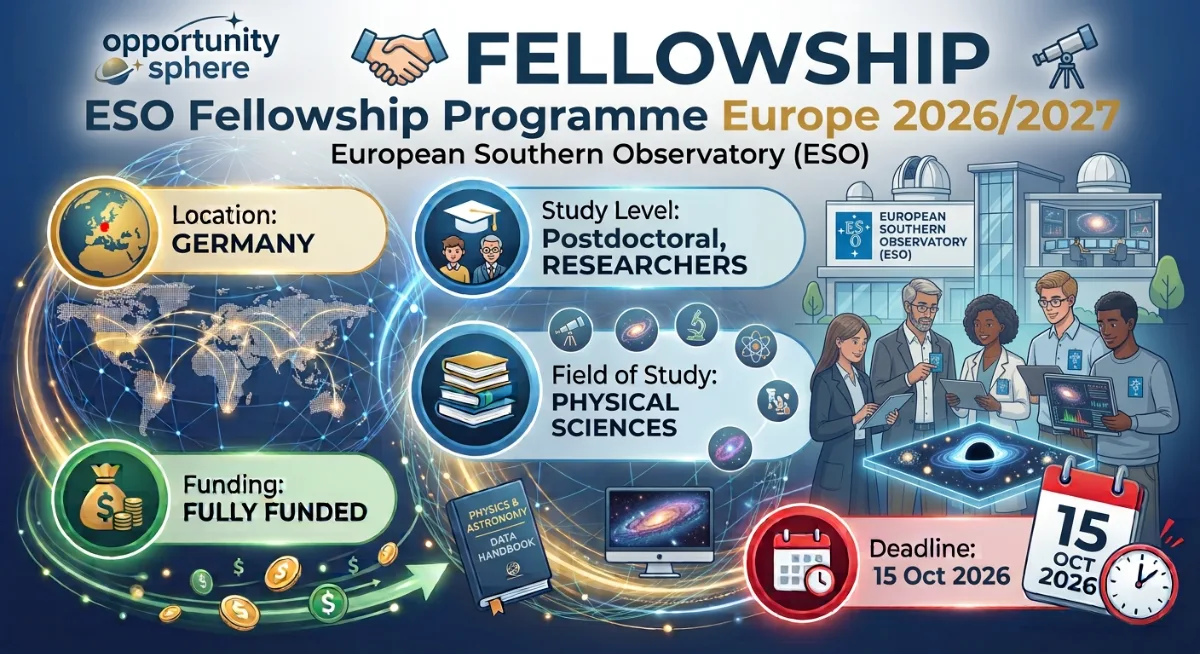
ESO Fellowship Programme Europe 2026/2027
Offered by European Southern Observatory (ESO)
Location
Germany
Funding
Fully Funded
Study level
Postdoctoral, Researchers
Field of study
Physical Sciences
Application deadline
October 15, 2026
Application Closed
About This Fellowship
The ESO Fellowship Programme Europe is a three-year postdoctoral fellowship based at the European Southern Observatory's headquarters in Garching near Munich, Germany. It is intended for early-career scientists who are ready to establish greater independence in their research careers.
The fellowship combines an individual research programme with participation in the scientific and technical activities of ESO. Fellows work alongside ESO astronomers, instrument experts, engineers and other researchers while developing their own scientific projects.
ESO's Garching headquarters is located on the campus of the Technical University of Munich (TUM) and close to several Max Planck institutes. The surrounding research environment provides access to a large concentration of astronomy and astrophysics researchers. ESO also participates in the ORIGINS Cluster, an interdisciplinary research environment involving scientists working on the origin and evolution of the Universe.
Independent Research
The central component of the Europe Fellowship is the development of an independent research programme.
Applicants are expected to propose a research plan that demonstrates scientific originality, sound methodology and the potential to make a meaningful contribution to their field. The current ESO selection process places particular emphasis on the Research Plan during the first stage.
The programme is open across astrophysics rather than being restricted to one particular research topic. ESO specifically welcomes applicants working in observational, theoretical and computational astrophysics.
Possible research areas include:
Exoplanets and planetary systems
Stellar astrophysics
Galaxy formation and evolution
Cosmology
Fundamental astrophysics
Interstellar medium and star formation
Active galactic nuclei
Observational astronomy
Advertisement
🔒Application Closed
The listed deadline has passed. Check the official website to see whether the organisation has announced an extension or a new application period.
Stay in the loop
Your Next Opportunity Could Be One Email Away
Receive updates about scholarships, jobs, internships, fellowships and grants so you can discover opportunities worth exploring.
Stay Updated
Never miss an opportunity.
Get updates on scholarships, jobs, internships, grants, fellowships, conferences, and other opportunities delivered straight to your inbox.
Applicants should develop a research programme that fits their scientific background while taking advantage of the expertise and facilities available within the ESO environment.
The 25% Functional Component
A distinctive feature of the Garching fellowship is that Fellows spend 25% of their time on functional work for ESO.
This component allows Fellows to contribute to projects proposed by different ESO departments and gain experience in areas connected with observatory operations, high-level technology and instrumentation.
The functional work is intended to complement, rather than replace, the Fellow's research programme. It can provide experience in the practical and technical activities required to operate a major international astronomical organisation.
Depending on the available projects and the Fellow's interests, activities can involve areas such as instrumentation, science operations, technology and other ESO projects.
Scientific Community
Fellows are expected to participate actively in the scientific life of ESO rather than working only on their individual projects.
Examples of activities include:
Organising or contributing to scientific workshops
Participating in research groups
Organising seminars
Co-supervising PhD students
Participating in scientific committees
Developing research collaborations
Preparing competitive research proposals
Preparing telescope-time proposals
Interacting with ESO scientists and visiting researchers
These activities can help early-career scientists develop experience in the broader responsibilities associated with an independent research career.
Who Can Apply
The current programme is open to applicants who will have obtained their PhD in astronomy, physics or a related discipline before 1 November 2027.
Applicants may come from different areas of astrophysics, including:
Observational astrophysics
Theoretical astrophysics
Computational astrophysics
Fundamental astrophysics
Astronomy-related physics
There is no requirement to be working in one particular subfield. The important consideration is whether the applicant has the scientific background and research programme appropriate for the ESO environment.
Research Excellence and Selection
Scientific excellence is the primary basis for selection.
For the Europe Fellowship, the first stage places particular emphasis on the proposed Research Plan. ESO evaluates whether the proposed programme is:
Bold
Original
Scientifically sound
Capable of producing meaningful scientific impact
Candidates who progress beyond the initial stage undergo a more detailed assessment of their scientific record, experience, research maturity and ability to carry out the proposed programme.
Shortlisted candidates are subsequently invited to an interview process that includes an online science talk followed by a video interview.
Remuneration and Support
The fellowship provides an attractive remuneration package, including:
Competitive salary
Allowances
Comprehensive social benefits
Financial support for relocation of eligible families
ESO publishes additional information about salaries and conditions of employment in its terms of service and fellowship FAQ. Actual remuneration can depend on factors such as previous postdoctoral experience and personal circumstances.
The ESO Office for Science also provides support for scientific activities such as international conferences, workshops and scientific visits to other research institutions. Additional limited research funding may be available through competitive internal processes.
Professional Development
The fellowship is structured to help researchers progress toward greater scientific independence.
In addition to conducting research, Fellows can gain experience in:
Scientific project development
Observatory operations
Instrumentation and technology
Research collaboration
Scientific leadership
Student supervision
Grant writing
Telescope proposal preparation
Workshop and seminar organisation
Research-group coordination
The combination of independent research and ESO functional work provides experience in both scientific and organisational aspects of astronomy.
Application Materials
The application consists of three principal documents:
Motivation Letter Form
Research Plan Form
Academic and Research Track Record Form
All three documents must be completed using the required ESO templates and uploaded as PDF files through the ESO Recruitment Portal.
Applicants must also provide the names and contact details of three people familiar with their scientific work who are willing to provide recommendations.
For the Europe programme, referees are contacted only if the candidate progresses to the second stage. Candidates who pass the first stage are encouraged to contact their referees immediately. The current deadline for the second-stage reference letters is 10 December 2026.
Selection Timeline
Application Deadline: 15 October 2026
First-stage outcome: Second half of November 2026
Shortlisted candidates contacted: 18–22 December 2026
Interview week: 12–22 January 2027
Expected offers: End of January 2027
Offer acceptance deadline: 15 February 2027
The current ESO announcement states that incomplete or late applications will not be considered.
Who Is This Fellowship For?
This programme is particularly suited to early-career scientists who:
Have completed or are on track to complete a PhD in astronomy, physics or a related field.
Want to establish an independent research programme.
Have a strong scientific track record.
Can formulate an original and well-developed research plan.
Want to work within a major international astronomy organisation.
Are interested in both scientific research and observatory-related activities.
Want experience collaborating across research disciplines and institutions.
Are interested in developing toward future scientific, technical or supervisory responsibilities.
Important Information
The Europe Fellowship is based in Garching, Germany.
The fellowship lasts three years.
Fellows spend approximately 75% of their time on their research programme and 25% on functional ESO activities.
Applicants must have obtained their PhD before 1 November 2027.
Observational, theoretical and computational astrophysics are all eligible.
The first-stage Europe selection places particular emphasis on the Research Plan.
Approximately 5–6 Fellows are recruited each year in Garching.
The programme is separate from the ESO Studentship Programme, which is for doctoral researchers.
It is also separate from the ESO Fellowship Programme in Santiago, Chile, which follows a different structure.
Applicants should use the official ESO templates rather than preparing substitute documents.
References are requested at the second stage for Europe applicants.
Late or incomplete applications are not considered.
How to Apply
Submit the application online through the ESO Recruitment Portal. Complete the Motivation Letter, Research Plan and Academic and Research Track Record forms, upload them as PDFs and provide the details of three potential referees.
Related Opportunities
Explore other scholarships, fellowships, grants, research opportunities and more that may match your interests.