Clooney Foundation for Justice (CFJ) Fellowship Programme 2027
Offered by Clooney Foundation for Justice
Location
Kenya, Malawi, South Africa and The Gambia
Funding
Paid
Study level
Undergraduate, Professional
Field of study
Law
Application deadline
October 20, 2026
About This Fellowship
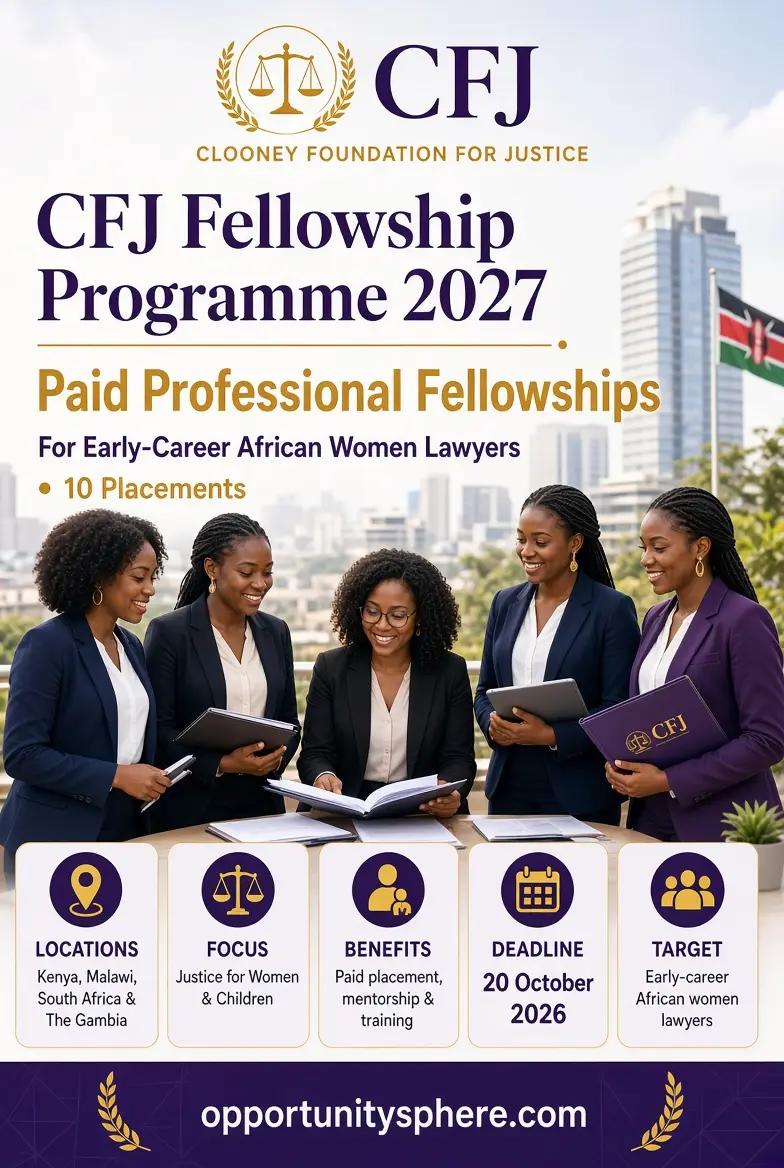
The Clooney Foundation for Justice (CFJ) Fellowship Programme 2027 provides paid professional fellowship placements for early-career African women lawyers who are interested in advancing justice for women and children.
The programme, formerly known as the Waging Justice for Women Fellowship Programme, provides fellows with the opportunity to work directly with organisations involved in human rights, legal advocacy and access to justice. Through their placements, fellows gain practical experience in legal research, legal writing, client support, legal representation, strategic litigation and advocacy.
The fellowship is designed to bridge the gap between formal legal education and practical professional experience. Rather than being solely classroom-based, participants work within host organisations and contribute to real legal and justice-related activities under professional supervision.
For the 2027 fellowship cycle, placements are available in Kenya, Malawi, South Africa and The Gambia.
The programme focuses particularly on issues affecting women and children, including access to justice, gender-based violence, child marriage, legal representation and strategic litigation.
1. Eligibility
The fellowship is intended for early-career African women lawyers who are interested in using their legal training to advance human rights and justice.
Applicants must meet the legal qualification and professional requirements established by the fellowship programme and must be eligible to undertake professional work in the relevant host country.
Because the fellowship involves practical legal work, applicants should pay particular attention to the professional requirements applicable to the country and host organisation they are applying to.
Candidates should generally demonstrate:
A recognised legal qualification appropriate to the programme requirements.
Professional eligibility to undertake the relevant legal work.
An interest in human rights, access to justice and gender justice.
Strong legal research and writing abilities.
Strong communication and analytical skills.
A commitment to advancing justice for women and children.
The ability to work effectively within a professional legal or human-rights organisation.
Applicants should review the specific requirements for the host-country placement before submitting their application.
2. Fellowship Locations
The 2027 fellowship placements are located in four African countries:
The location of the fellowship is important because legal professional requirements can differ between jurisdictions.
Candidates should therefore ensure that they understand the relevant professional and eligibility conditions for the country associated with the placement they are applying for.
The international nature of the programme also gives fellows an opportunity to gain professional experience within different African justice systems and to engage with organisations addressing issues affecting women and children.
3. Fellowship Placement
The programme provides 10 fellowship placements with organisations working on justice and human-rights issues.
Host organisations may include:
Legal aid organisations.
University legal aid clinics.
Government legal institutions.
Human-rights organisations.
Other organisations working to improve access to justice.
Fellows work directly within their host organisations and contribute to ongoing legal and justice-related activities.
This placement-based approach enables participants to gain practical experience while receiving supervision from experienced professionals.
The work undertaken by fellows may vary according to the needs of the host organisation and the specific justice issues being addressed.
4. Responsibilities and Professional Experience
Fellows can expect to participate in practical legal work rather than simply observing the activities of their host organisations.
Depending on their placement, responsibilities may include:
Conducting legal research.
Preparing legal documents.
Drafting legal and advocacy materials.
Supporting clients.
Assisting with legal representation.
Contributing to strategic litigation.
Supporting human-rights advocacy.
Researching laws and policies affecting women and children.
Contributing to initiatives designed to improve access to justice.
Supporting the development of innovative approaches to legal services.
The exact responsibilities will depend on the host organisation and the nature of the placement.
The fellowship therefore provides participants with an opportunity to apply legal knowledge in real-world settings while developing practical professional skills.
5. Justice for Women and Children
A central component of the programme is its focus on improving justice for women and children.
Fellows may encounter legal and human-rights issues involving:
Violence against women and children.
Gender-based violence.
Child marriage.
Access to justice.
Legal representation.
Protection of vulnerable groups.
Strategic litigation.
Human-rights advocacy.
Legal and institutional barriers to justice.
Policies affecting women and children.
This focus allows participants to develop experience in areas where legal practice, human rights and social justice intersect.
6. Strategic Litigation and Advocacy
Strategic litigation is an important element of the fellowship's professional focus.
Strategic litigation can involve using legal cases to address broader legal or systemic issues affecting communities or groups of people.
Fellows may therefore have opportunities to contribute to research, case preparation, legal analysis and advocacy associated with broader justice objectives.
The programme also encourages participants to consider how legal practice can be combined with advocacy and innovative approaches to improve access to justice.
This can help fellows develop an understanding of how individual legal cases may connect to wider human-rights and policy issues.
7. Technology and Access to Justice
The programme encourages fellows to consider the role that innovative technology can play in improving access to justice.
Technology can potentially assist legal and human-rights organisations in areas such as information access, communication, legal research, service delivery and outreach.
By exposing fellows to innovative approaches alongside traditional legal practice, the programme aims to encourage participants to think creatively about how barriers to justice can be addressed.
This aspect may be particularly relevant to early-career lawyers interested in combining legal expertise with innovation and public-interest advocacy.
8. Benefits
The CFJ Fellowship Programme provides a combination of paid professional experience, mentorship, training and networking opportunities.
Key benefits include:
Paid professional placement: Fellows receive a competitive gross annual salary in local currency.
Professional experience: Participants gain practical experience working within a justice or human-rights organisation.
Mentorship: Fellows receive guidance from the Justice for Women & Children Programme Director, host-organisation supervisors and regional human-rights experts.
Professional training: Participants take part in monthly online training sessions.
In-person convening: Fellows participate in an in-person convening involving fellows, supervisors and CFJ leadership.
Professional network: Participants gain access to a network of lawyers, judges, activists and academics.
Alumni opportunities: Successful fellows join the CFJ Fellowship Alumni Programme after completing the fellowship.
The combination of paid employment, supervision and structured professional development makes the fellowship an opportunity to gain practical experience while developing a career in public-interest law and human rights.
9. Mentorship and Professional Development
Mentorship is an important part of the fellowship experience.
Participants receive support from several levels of professional leadership, including the Justice for Women & Children Programme Director, supervisors within their host organisations and regional human-rights experts.
This structure can provide fellows with exposure to different perspectives on legal practice and human-rights advocacy.
The monthly online training sessions provide an additional structured learning component, allowing fellows to continue developing their professional knowledge during their placements.
The in-person convening also provides an opportunity for fellows and programme leaders to meet, exchange experiences and discuss issues connected with their work.
10. Professional Network and Alumni Opportunities
Fellows become part of a professional network that includes lawyers, judges, activists and academics.
Building these professional relationships can provide opportunities for knowledge exchange and collaboration during and after the fellowship.
After completing the programme, fellows join the CFJ Fellowship Alumni Programme.
The alumni network provides a continuing connection with other professionals who have participated in the fellowship and are working in areas related to justice and human rights.
11. Skills Applicants Should Demonstrate
The fellowship is aimed at early-career lawyers who can demonstrate strong professional potential.
Applicants should highlight relevant skills and experiences such as:
Legal research.
Legal writing.
Analytical reasoning.
Communication.
Advocacy.
Research and evidence analysis.
Interest in human rights.
Interest in gender justice.
Commitment to improving access to justice.
Ability to work collaboratively in a professional environment.
Applicants should also explain how their legal background and professional interests connect with the objectives of the fellowship.
12. Application Information
Applicants should prepare the materials required by the official CFJ application platform.
Candidates should be prepared to provide evidence of their legal qualifications and professional eligibility where required.
The application should also demonstrate the applicant's interest in justice and human rights and their suitability for practical legal work.
Applicants should carefully review the requirements associated with the available fellowship placements, particularly because professional legal requirements can differ between host countries.
The application deadline is 20 October 2026.
Candidates should submit their applications electronically through the official CFJ application platform before the stated deadline.
13. Important Note
The programme was renamed the CFJ Fellowship Programme in August 2026. Older information about the opportunity may therefore still refer to it as the Waging Justice for Women Fellowship Programme.
Applicants searching for information online should be aware that both names may appear in older materials.
Candidates should rely on the current official programme information when checking eligibility, placement details, application requirements and deadlines.
Because the fellowship involves professional legal work, applicants should pay particular attention to the legal qualification and work-eligibility requirements applicable to their selected host-country placement.
Application Deadline: 20 October 2026
Funding: Paid Fellowship
Study Level: Professional
Field: Law, Human Rights, Gender Justice and Legal Advocacy
Location: Kenya, Malawi, South Africa and The Gambia
Number of Fellowships: 10
Target Group: Early-career African women lawyers
Related Opportunities
Explore other scholarships, fellowships, grants, research opportunities and more that may match your interests.