MOPGA 2027 Visiting Fellowship Program for Early Career Researchers
Offered by Campus France, on behalf of the French Ministry for Europe and Foreign Affairs (MEAE), in partnership with the Ministry of Higher Education, Research and Space (MESRE)
Location
France
Funding
Fully Funded
Study level
Postdoctoral, Researchers
Field of study
Social Sciences, Environmental Sciences, Arts & Humanities
Application deadline
December 15, 2026
About This Fellowship
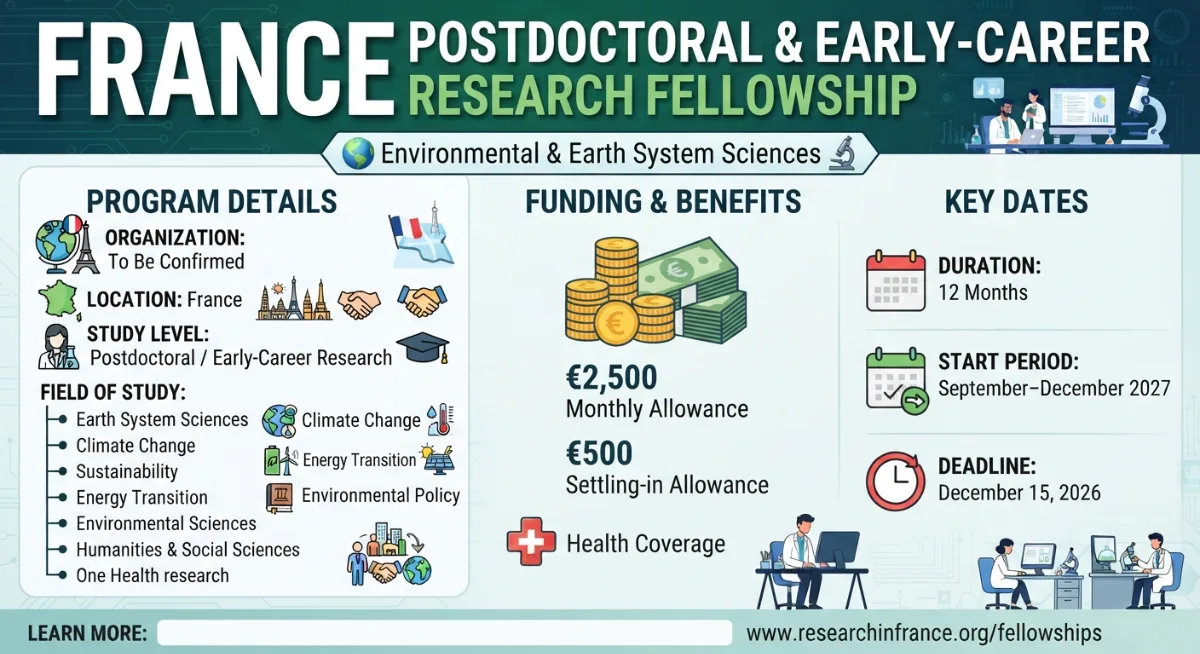
The Make Our Planet Great Again (MOPGA) Visiting Fellowship Program supports early-career researchers from outside France who want to undertake a 12-month research project at a French higher education or research institution.
The 2027 call focuses on environmental and climate-related challenges and welcomes projects addressing areas such as sustainability, environmental change, energy systems and One Health. Interdisciplinary research is also encouraged where the proposed work clearly fits one of the programme's eligible themes.
MOPGA was launched in 2018 and has supported more than 520 students and researchers from 78 countries. The 2027 programme is funded by the French Ministry for Europe and Foreign Affairs in partnership with the French Ministry of Higher Education, Research and Space and implemented by Campus France.
This is a research-mobility fellowship, not a degree programme. Applicants must already hold a PhD and develop a defined research project for a 12-month stay in France.
Research Themes
The 2027 call covers five main areas:
Earth system sciences
Climate change and sustainability sciences
Energy transition
Societal challenges related to environmental issues
Human, animal and ecosystem health under the One Health approach
High-technology approaches applied to these themes are encouraged. Depending on the project, this can include areas such as artificial intelligence, modelling, data analysis and other advanced research methods.
Researchers in the humanities and social sciences may also apply when their proposed research directly addresses an eligible environmental, climate or sustainability challenge.
For One Health projects, the environmental dimension must be meaningful. Research focused solely on human medicine or human health without a connection to animals or ecosystems would not fit the stated theme.
Eligibility
Applicants must:
Hold a doctoral degree obtained less than five years before the application deadline.
Have defended their PhD between December 2021 and December 2026, inclusive.
Be a foreign national; French nationals are not eligible.
Be applying for research mobility to France.
Not be residing and professionally active in France when applying.
Not have previously received a MOPGA fellowship.
Researchers who have completed their thesis defence but have not yet received the final doctoral certificate may provide official documentation confirming the defence.
The five-year eligibility period may be extended for maternity leave, subject to the programme's conditions and supporting documentation. The stated extension can be up to 18 months per child or the actual duration of maternity leave, as applicable.
MOPGA is intended for researchers who have already completed their doctoral defence. Current Master's and PhD students are therefore not eligible.
Fellowship Benefits
Successful fellows receive:
€2,500 per month for 12 months.
€500 settling-in allowance during the first month.
Health insurance coverage.
Civil liability insurance.
Repatriation assistance.
Supplementary health insurance after registration with the French social security system.
A 12-month research stay at a French institution.
The fellowship is paid directly by Campus France.
Costs the Fellowship Does Not Automatically Cover
Applicants should distinguish between fellowship support and research expenses.
International travel to France is not included in the MOPGA fellowship. A host laboratory may choose to assist with travel costs, but this is not guaranteed.
MOPGA also does not provide a separate research budget for laboratory consumables, equipment or other project expenses. Researchers whose projects require substantial laboratory, fieldwork or equipment costs should agree with the proposed host institution in advance on how those expenses will be covered.
The host laboratory itself does not receive MOPGA funding.
Research Project
The application must contain a specific research project with a realistic plan for the 12-month stay.
The online application requires:
Project title.
Six keywords.
Research summary — up to 2,000 characters.
Background and motivation — up to 2,000 characters.
Scientific objectives — up to 2,000 characters.
Methodology and timeline — up to 4,500 characters.
Relevance to MOPGA — up to 2,000 characters.
International collaboration and/or expected impact for the applicant's country of residence or origin — up to 2,000 characters.
Applications may be submitted in English or French.
The methodology and timeline section has the largest character limit. Applicants should use it to show exactly how the research will be carried out during the fellowship, including the main activities, methods, expected outputs and timing.
The proposal should also demonstrate why the work belongs within MOPGA's environmental or climate priorities and explain how the research could contribute to the applicant's country of origin or residence.
Finding a French Host Laboratory
A suitable French host laboratory is required before the application is submitted.
Applicants should identify a research unit whose expertise, facilities and ongoing work match the proposed project. Campus France recommends using research laboratory directories, the Research in France portal, existing academic contacts and previous collaborations when identifying potential hosts.
The prospective scientific supervisor must provide a letter of support. This must be co-signed by the laboratory director or accompanied by a separate commitment from the laboratory director confirming that the necessary research environment and resources will be available.
This makes host selection more than a formal requirement. Applicants should confirm beforehand that the laboratory can realistically support the proposed methods, facilities and research activities for the full 12-month period.
Application Documents
Applicants should prepare:
CV with publication list, maximum four pages.
Doctoral degree certificate or official proof of the completed degree.
CV of the proposed French scientific supervisor, maximum two pages.
Letter of support from the scientific supervisor.
Laboratory director's co-signature or separate commitment letter.
One to three recommendation letters.
Passport or national identity document.
Because several documents depend on the French host institution, applicants should begin contacting potential supervisors well before the application deadline.
Selection Process
MOPGA uses a two-stage scientific selection process.
Applications are first assessed by scientific experts appointed by the French Ministry of Higher Education, Research and Space in the relevant research areas. A scientific committee then makes the final selection.
The quality of the research project, its relevance to the MOPGA themes and the suitability of the proposed research environment are therefore central to the application.
Important Conditions
The fellowship:
Lasts for 12 months.
Cannot be renewed.
Cannot be combined with a French employment contract, including a research or postdoctoral employment contract.
Cannot be combined with another individual funding award from the French government.
Applicants should therefore check their existing funding and employment arrangements before accepting a MOPGA fellowship.
Application Advice
Do not approach a French laboratory with only a broad research interest. Prepare a concise description of the problem, objectives, proposed methods and expected contribution before contacting potential supervisors.
For the application itself:
Make the connection between the project and one of the five MOPGA themes explicit.
Use the methodology section to provide a realistic 12-month work plan.
Demonstrate why the proposed French laboratory is appropriate for the project.
Explain what the research could contribute beyond the fellowship period, particularly in the applicant's country of origin or residence.
Make sure the host supervisor's expertise clearly complements the proposed research.
Discuss laboratory, fieldwork, equipment and travel costs with the host institution before submission.
Start securing the host and supporting documents early rather than waiting until December.
Timeline
September 15, 2026: Applications open.
December 15, 2026: Application deadline.
May–June 2027: Results communicated.
September–December 2027: Successful fellows begin their research stays in France.
Important Deadline
The deadline for the MOPGA 2027 Visiting Fellowship Program is December 15, 2026.
The application should not be left until the deadline because applicants need time to develop the research proposal, secure a French host, obtain the required host documents and arrange recommendation letters.
How to Apply
Applications must be submitted online through the official Campus France SMApply platform. Applications sent by email are not accepted.
Applicants should review the official application guide and FAQ before submitting because the online form imposes specific character limits and documentation requirements.
Related Opportunities
Explore other scholarships, fellowships, grants, research opportunities and more that may match your interests.