The Harry Ransom Center Fellowships 2027–2028 provide financial support and access to exceptional primary-source collections for scholars, graduate students, independent researchers, artists and other qualified applicants whose projects require substantial on-site research at the Center.
The Harry Ransom Center is a major humanities research library and museum located at The University of Texas at Austin in the United States. Its collections contain rare books, manuscripts, photographs, films, artworks, archives and other historical materials documenting important developments in literature, culture, the arts, media and intellectual history.
The fellowship programme is particularly valuable for researchers whose work depends on materials that cannot be adequately examined through digitised resources or conventional online research. Fellows are given an opportunity to work directly with archival and primary-source materials while benefiting from the research environment of one of the world's major humanities collections.
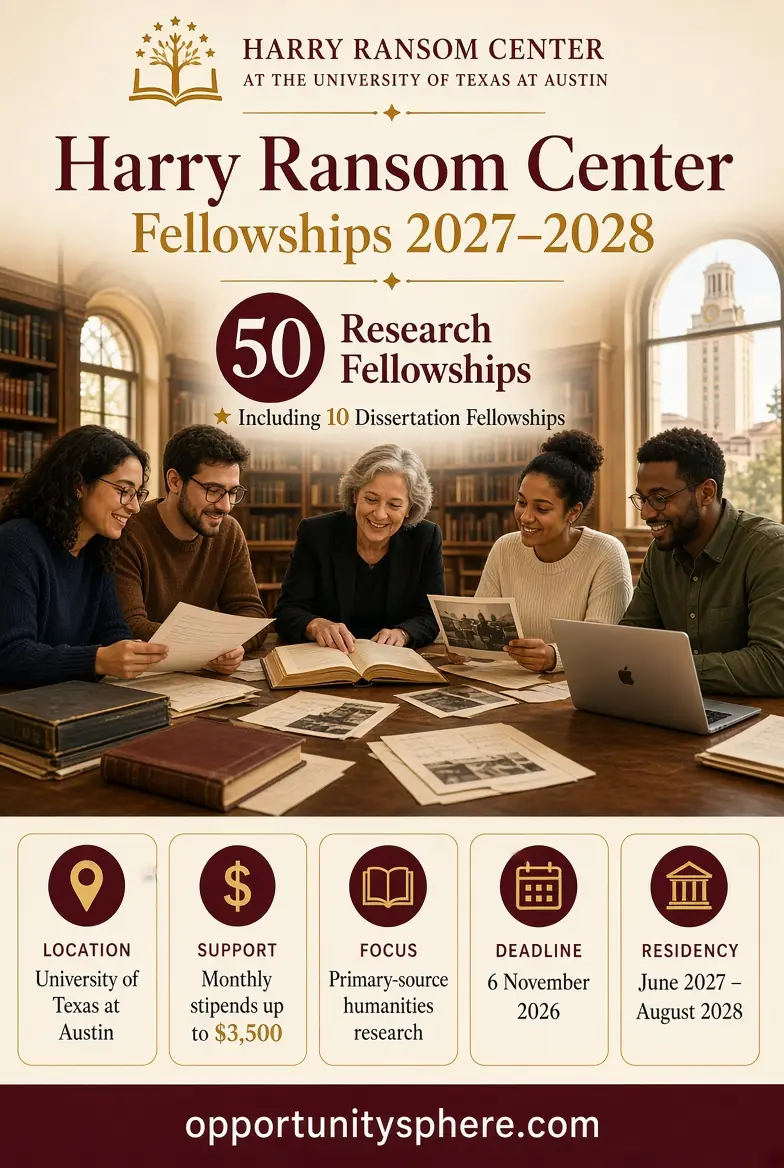
For the 2027–2028 fellowship cycle, the Center expects to award approximately 50 research fellowships, including approximately 10 dissertation fellowships. The programme accommodates researchers at different stages of their careers and supports a wide variety of scholarly and creative projects.
Projects supported through the fellowships may include doctoral dissertations, academic books, journal articles, archival research, creative works, exhibitions, digital humanities projects, documentary or film-related research, and interdisciplinary studies.
The programme is therefore not limited to one academic discipline. Instead, applicants are selected based on the quality and significance of their proposed projects and, importantly, the extent to which the Harry Ransom Center's collections are essential to the research.
1. Who Can Apply
The fellowship programme supports several categories of researchers, allowing applicants from different academic and professional backgrounds to seek funding for collection-based research.
Potential applicants may include:
Graduate students undertaking advanced research.
Doctoral candidates working on dissertation projects.
Postdoctoral researchers developing new scholarly projects.
Current or former academic faculty members.
Independent scholars conducting substantial research outside a university appointment.
Journalists undertaking serious historical or cultural research.
Artists and creative practitioners whose projects require access to the Center's collections.
Researchers working across multiple disciplines where the Center's holdings are central to the proposed project.
Eligibility and funding arrangements vary according to the specific fellowship category. Applicants should therefore identify the category that best matches their academic or professional status before preparing their application.
2. Research Areas
The Harry Ransom Center's collections cover a broad range of subjects within the humanities, arts and cultural history.
Proposed projects may involve:
Literature and literary history.
Manuscript and archival studies.
Photography.
Film and cinema history.
Art and art history.
Performing arts.
Music and music history.
Cultural and intellectual history.
Book history and publishing.
Digital humanities.
Media studies.
Interdisciplinary humanities research.
Creative writing and artistic research.
Exhibition and museum-related research.
Projects examining historical documents, visual materials or other primary sources.
Applicants do not necessarily need to work within a traditional academic discipline. The important consideration is whether the proposed project makes meaningful use of the Center's holdings and whether the research requires access to materials held in its collections.
3. Importance of the Ransom Center Collections
A central feature of the fellowship programme is the requirement that the proposed research make substantial use of the Harry Ransom Center's collections.
Applicants should therefore demonstrate that the Center is not simply a convenient research destination but an important source of evidence for their project.
A strong proposal should explain:
Which collections are relevant to the research.
What types of primary materials the applicant intends to examine.
How those materials contribute to the research question.
Why the materials cannot be adequately replaced by publicly available digital resources.
How the proposed period of residence will contribute to the completion of the project.
Researchers are encouraged to investigate the Center's online collection information before applying so that their proposal can identify relevant holdings as specifically as possible.
4. Fellowship Categories and Financial Support
The Harry Ransom Center offers several forms of fellowship and research support.
For the 2027–2028 cycle, the programme includes different awards designed for researchers at different career stages.
Postdoctoral fellowships provide $3,500 per month for eligible scholars and may support one or two months of research.
Dissertation fellowships provide $2,500 for doctoral students whose dissertation research requires access to the Center's collections.
Travel stipends provide $2,000 for eligible graduate students, faculty members and independent researchers undertaking research at the Center.
International researchers may also receive an additional one-time $500 stipend intended to contribute toward eligible J-1 visa and/or international travel costs.
Because the awards have different purposes and eligibility conditions, applicants should carefully review the fellowship category applicable to their circumstances rather than assuming that all applicants receive the same level or duration of support.
5. What the Fellowship Can Support
The fellowship can contribute to a wide range of scholarly, research and creative projects.
Supported work may include:
Doctoral dissertations.
Academic books and monographs.
Scholarly journal articles.
Historical and archival research.
Creative writing projects.
Film and media-related projects.
Digital humanities research.
Exhibition development.
Performance-related research.
Interdisciplinary research.
Archival and documentary projects.
Other substantial projects that depend on the Center's collections.
The fellowship can be particularly useful for researchers who have reached a stage where direct examination of primary sources is necessary to move their project forward.
6. Research Environment and Collection Access
Successful fellows conduct their research within the Harry Ransom Center's research environment in Austin, Texas.
Rather than receiving funding alone, fellows gain an opportunity to work directly with the Center's specialised collections and research resources.
This can allow researchers to:
Examine original archival materials.
Consult rare books and manuscripts.
Study historical photographs and visual materials.
Review archival documents that may not be available elsewhere.
Compare multiple primary sources within a single research environment.
Develop new evidence for scholarly or creative work.
Strengthen the primary-source foundation of an existing research project.
The experience can therefore contribute not only to the immediate research project but also to the researcher's broader academic or professional development.
7. Application Requirements
Applicants are required to submit a research proposal of approximately three pages together with one confidential recommendation letter.
The research proposal should clearly communicate the purpose and significance of the proposed project.
Applicants should explain:
The central research problem or project.
The significance of the proposed research.
The main research questions.
The expected scholarly, creative or professional outcomes.
The specific Harry Ransom Center collections that will be consulted.
Why access to those collections is important.
Why on-site research is necessary.
How the Center's materials will contribute to the larger project.
What the applicant expects to accomplish during the fellowship period.
Applicants are encouraged to identify specific collections, and where possible, particular containers, boxes and folders relevant to their research.
This level of specificity can help demonstrate that the applicant has carefully investigated the Center's holdings and has a realistic understanding of how the collections will be used.
8. Recommendation Letter
The application also requires one confidential recommendation letter.
Applicants should select a referee who can provide meaningful information about their academic, research or professional preparation and their ability to complete the proposed project.
The recommendation should ideally complement the research proposal by providing evidence of the applicant's:
Research ability.
Academic or professional preparation.
Capacity for independent work.
Suitability for the proposed project.
Potential contribution to their field or area of practice.
Applicants should allow sufficient time for the referee to prepare and submit the confidential recommendation before the application deadline.
9. Fellowship Residency
Fellowship residencies for the 2027–2028 cycle must be completed between 1 June 2027 and 31 August 2028.
Researchers are expected to spend the majority of their working days making use of the Center's collections during their fellowship period.
The residency requirement is important because the programme is specifically designed to support intensive, on-site collection-based research.
Applicants should therefore consider their academic, professional and personal schedules before selecting a proposed research period.
International applicants should also take into account the time required for travel arrangements and, where applicable, visa processing.
10. Who May Benefit From the Fellowship
The fellowship may be particularly relevant to researchers who have reached a stage where access to primary sources is essential to completing or substantially advancing their work.
Potential applicants may include:
PhD students conducting dissertation research.
Postdoctoral scholars developing publications from previous research.
Faculty members preparing books or major research projects.
Artists developing historically or culturally informed projects.
Journalists conducting substantial historical or cultural research.
Humanities researchers developing digital or interdisciplinary projects.
The programme may be especially valuable where the relevant materials are rare, unique or difficult to access outside the Center.
11. Preparing a Strong Application
Applicants should begin by identifying the exact collections that are relevant to their proposed project.
A useful preparation process includes:
Reviewing the Harry Ransom Center's collection information.
Identifying relevant archives, manuscripts or other primary sources.
Refining the research question.
Explaining the relationship between the project and the collections.
Developing a realistic research plan.
Preparing the three-page proposal.
Selecting an appropriate recommender.
Allowing sufficient time for the confidential recommendation to be submitted.
Reviewing all application requirements before submission.
Applicants should avoid submitting a generic research proposal that could be carried out at any library or archive. The application should clearly establish why the Harry Ransom Center is important to the proposed work.
12. Application Deadline
The application deadline for the 2027–2028 fellowship cycle is 6 November 2026 at 5:00 PM Central Standard Time.
Applicants should ensure that the complete application, including the required recommendation letter, is submitted according to the Center's instructions before the deadline.
Late or incomplete applications may not receive consideration, so applicants should begin the process early.
13. Selection and Notification
The fellowship programme is competitive, with approximately 50 research fellowships expected to be awarded for the 2027–2028 cycle, including approximately 10 dissertation fellowships.
Selection is based on the quality and significance of the proposed research and the applicant's need to use the Center's collections.
Applicants should demonstrate a clear connection between their project and the primary materials available at the Ransom Center.
Fellowship decisions are expected to be communicated by email in April 2027.
14. Why This Fellowship Is Relevant to Researchers
The Harry Ransom Center Fellowships offer more than short-term financial assistance. They provide researchers with an opportunity to conduct concentrated primary-source research in an internationally recognised humanities collection.
For researchers whose projects depend on archival evidence, rare materials or historical collections, a period of dedicated on-site research can help them:
Gather primary evidence for a dissertation or book.
Strengthen the originality of their research.
Examine materials unavailable through ordinary online databases.
Develop scholarly publications.
Complete important stages of a long-term research project.
Produce creative or exhibition-based work.
Build experience working with major archival collections.
The fellowship is therefore particularly suited to projects in which the collections themselves are central to the research methodology and outcomes.
15. Application Information
Prospective applicants should review the official fellowship instructions carefully before applying because eligibility, funding arrangements and requirements can differ between fellowship categories.
For the 2027–2028 cycle, the application deadline is 6 November 2026 at 5:00 PM Central Standard Time, while fellowship residencies must be completed between 1 June 2027 and 31 August 2028.
Applicants should also verify the latest official information regarding fellowship amounts, residency requirements, collection access and international researcher arrangements before submitting an application.
Related Opportunities
Explore other scholarships, fellowships, grants, research opportunities and more that may match your interests.