The application deadline for this opportunity has passed. You can still review the details, but the listing is no longer presented as open for applications.
Fellowship, Course & Training
African Union Enterprise Africa Network Fellowship Programme 2026/2027
Offered by African Union Commission
Location
Africa
Funding
Fully Funded
Study level
Entrepreneurs / Professionals
Field of study
All Fields
Application deadline
September 30, 2026
Application Closed
About This Fellowship
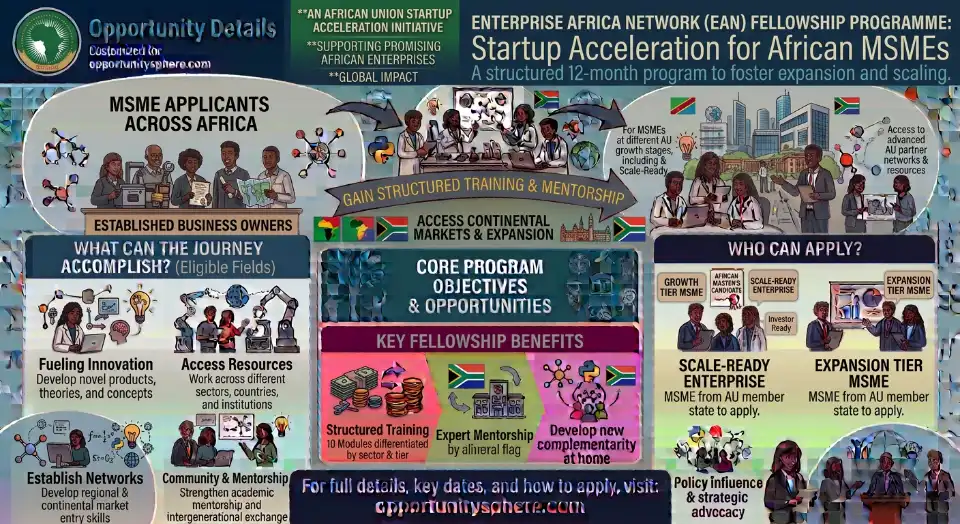
The Enterprise Africa Network (EAN) Fellowship Programme is an African Union Commission initiative designed to strengthen African micro, small and medium-sized enterprises (MSMEs) and help promising businesses prepare for growth beyond their existing markets.
Implemented through the African Union Commission's Department of Economic Development, Trade, Tourism, Industry and Minerals, the programme combines business training, expert mentorship, intellectual property support and access to trade intelligence. Its emphasis is not simply on helping entrepreneurs establish businesses, but on equipping existing enterprises with the knowledge, networks and strategies needed to improve their competitiveness and explore opportunities across African markets.
The second cohort, covering the 2026/2027 programme cycle, plans to select 100 fellows from across the African Union's 55 member states. The initiative is intended to help participating enterprises strengthen their operations, identify commercial opportunities, develop cross-border partnerships and contribute to employment and economic development.
The programme builds on its inaugural 2024/2025 cohort, which trained 56 fellows from 30 African countries and reportedly generated more than US$1 million in deals and contracts. For Cohort 2, the programme has set targets of US$2 million in new attributable revenue and 500 new jobs.
Who Should Consider This Fellowship?
The EAN Fellowship is intended for established, formally registered businesses rather than individuals who have only an idea for a future startup. It is particularly relevant to youth-led and women-led enterprises that have begun trading, developed a customer base and are looking for ways to improve their business performance or expand into additional markets.
The programme is organised around seven sectors in two broad clusters:
1. Products Cluster
This cluster focuses on businesses producing goods for trade within Africa. Relevant sectors include:
Manufacturing
Agro-processing
Creative industries
For example, an established agro-processing company that produces packaged food products could use market intelligence and business mentorship to investigate demand in neighbouring countries, assess potential distribution partners and understand the requirements for entering new markets.
Advertisement
🔒Application Closed
The listed deadline has passed. Check the official website to see whether the organisation has announced an extension or a new application period.
Stay in the loop
Your Next Opportunity Could Be One Email Away
Receive updates about scholarships, jobs, internships, fellowships and grants so you can discover opportunities worth exploring.
Stay Updated
Never miss an opportunity.
Get updates on scholarships, jobs, internships, grants, fellowships, conferences, and other opportunities delivered straight to your inbox.
This cluster covers enterprises delivering services, including:
Information and communications technology (ICT) and digital services
Financial technology (fintech)
Health
Logistics and transport
A digital services company, for instance, might use the programme to assess potential customers in other African markets, refine its expansion strategy or identify opportunities for commercial partnerships.
Businesses should verify that their principal activities fit one of the programme's stated sectors before considering a future application.
Eligibility Criteria
Applicants for Cohort 2 were required to meet the programme's enterprise-level eligibility conditions. The published call focused on formally registered, operating businesses rather than unregistered ideas or pre-launch ventures.
General requirements
Applicants were expected to:
Operate a formally registered business in an African Union member state.
Have operated for at least two years.
Employ a minimum of three full-time staff.
Operate in one of the programme's seven eligible sectors.
Demonstrate that the business has progressed beyond the idea stage and has evidence of market activity.
Identify a clear business or market challenge that the fellowship could help address.
Provide accurate information about the enterprise, including its registration, operations, workforce and commercial activities.
Meet the requirements of one of the three enterprise tiers.
The programme particularly encouraged applications from women-led enterprises and businesses in underrepresented African Union regions and small island member states.
The Three EAN Fellowship Tiers
Applicants were categorised according to the maturity and growth needs of their businesses. The published allocation for the 100 fellowship places was divided across three tiers.
Tier 1: Growth
Planned places: 35
Business age: Approximately 2–5 years
Workforce: At least three employees
Business profile: An operating enterprise with demonstrable market traction
This tier is intended for businesses that have established a presence in their market and want to improve their operations, strengthen their commercial strategy and explore opportunities for further growth.
Suitable businesses might be looking to understand customer demand more accurately, improve product positioning, strengthen their intellectual property strategy or assess whether their products or services could succeed in additional African markets.
Tier 2: Expansion
Planned places: 40
Business age: Approximately 5–10 years
Workforce: Generally 10–30 employees
Business profile: An established enterprise with cross-border expansion ambitions
The Expansion tier is designed for businesses that have developed a stronger operating base and are considering growth beyond their current market.
These enterprises may need to identify suitable distributors, understand regional market requirements, assess competition in other countries or build partnerships that can support cross-border trade.
Tier 3: Scale-Ready
Planned places: 25
Business age: Generally 10 years or more, or an investor-ready profile
Business profile: An enterprise preparing for more advanced growth and commercial opportunities
The Scale-Ready tier is intended for businesses with the maturity or investment readiness to pursue larger-scale opportunities. The official criteria allow for an investor-ready profile as an alternative to the ten-year operating history, so a business should consult the published call rather than relying on business age alone.
This tier places particular emphasis on business-to-business matchmaking and opportunities to build relationships that may support further commercial expansion.
The tier descriptions are intended to guide placement. Businesses should check the official call and application form for the precise requirements that apply to their circumstances.
Fellowship Benefits
The EAN Fellowship provides business-development support rather than functioning as a conventional academic scholarship. Its principal value lies in training, expert guidance, market intelligence and opportunities to develop commercial relationships.
1. Twelve months of structured business training
Selected fellows are expected to participate in a 12-month programme consisting of ten training modules. The modules are differentiated according to the enterprise's sector and growth tier, allowing the training to address the needs of businesses at different stages of development.
Depending on the enterprise's circumstances, relevant learning areas may include business strategy, market development, competitiveness and preparation for regional trade. Applicants should consult the programme's official materials for the detailed module curriculum.
2. Expert mentorship
Fellows receive mentorship through African Union partners. This provides an opportunity to receive guidance relevant to their business challenges, growth plans and commercial objectives.
Mentorship is particularly useful when a business needs to assess its readiness for expansion, clarify its target markets or develop a more structured approach to pursuing new customers and partners.
3. Access to African Trade Observatory resources
Participants gain access to the African Trade Observatory (ATO) and AfCFTA-related market intelligence tools. These resources can help businesses investigate trade patterns and identify potential market opportunities.
Market intelligence is valuable because expanding into another country involves more than finding prospective customers. Businesses need to understand demand, competitors, distribution arrangements and other factors that influence whether entering a market is commercially realistic.
4. Virtual market-entry sessions
Tier 1 and Tier 2 fellows are expected to participate in virtual market-entry sessions covering ten pilot countries associated with the African Continental Free Trade Area (AfCFTA).
These sessions are intended to help businesses explore possible entry points into additional markets and better understand the opportunities and challenges involved in cross-border trade.
Participation does not guarantee that an enterprise will secure customers, distribution agreements or export contracts.
5. Business-to-business matchmaking
Tier 3 fellows are expected to participate in business-to-business (B2B) matchmaking sessions.
These activities are intended to facilitate connections between enterprises and potential commercial partners. Such relationships may help businesses explore distribution, supply, collaboration or other commercial arrangements, depending on their sector and needs.
6. Intellectual property support
The programme includes intellectual property support, an important consideration for businesses whose value depends on brands, product designs, creative work, technology or other protectable assets.
Understanding intellectual property can help a business consider how to protect its assets and approach commercial partnerships in a more informed way. The precise support available should be confirmed through the programme's official documentation.
7. Continental events and networking
Fellows can participate in continental events and networking activities. These opportunities may help entrepreneurs exchange experience, learn from other businesses and establish relationships across African markets.
8. Support for regional and continental expansion
By combining training, mentorship, trade intelligence and networking, the programme aims to help enterprises prepare for growth beyond their current markets.
The extent to which an enterprise benefits will depend on its readiness, the quality of its business strategy, the relevance of the opportunities identified and its ability to act on the support provided.
Important Funding Information
The published EAN Fellowship announcement describes a business acceleration programme that offers training, mentorship, intellectual property support, market intelligence and market-access activities.
It does not specify a guaranteed cash grant, personal stipend, investment award or direct funding payment for every fellow. Entrepreneurs should therefore not treat the fellowship as a cash-funding opportunity unless the African Union confirms a separate financial benefit in official programme documentation.
Application Process
Applications for Cohort 2 were submitted online. The deadline has passed, but the following outlines the published application requirements for entrepreneurs preparing for a future cohort.
Step 1: Assess the enterprise's eligibility
Confirm that the business is formally registered and operating in an African Union member state, has operated for the required period, employs the minimum number of full-time staff and works in an eligible sector.
Step 2: Identify the appropriate tier
Review the Growth, Expansion and Scale-Ready categories. Select the tier that best reflects the enterprise's operating history, workforce, market traction and growth objectives.
Step 3: Prepare business information
Applicants were asked to provide details such as:
Business registration information
Sector and principal business activities
Years of operation
Number of employees
Countries in which the business currently trades
Relevant revenue information
Intellectual property status
Information about access to formal finance
Businesses should ensure that these details are consistent with their records. The African Union warns that misrepresentation can result in immediate disqualification and permanent ineligibility for future EAN Fellowship cohorts.
Step 4: Develop the written business pitch
The application required a written pitch of up to 800 words describing the enterprise, its principal market challenge and its objectives for participating in the fellowship.
A strong pitch should explain what the business does, who its customers are, what evidence demonstrates its progress and which specific challenge it wants to address. It should also explain how the programme's resources could help the enterprise work towards a realistic business objective.
For example, rather than simply stating that a company wants to expand across Africa, an applicant could explain that it has established domestic sales, identified a potential regional customer segment and needs better market intelligence and commercial partnerships to assess expansion opportunities.
The example above is illustrative; applicants should use their own verifiable business information.
Step 5: Prepare supporting financial evidence if requested
The published call stated that shortlisted applicants could be asked to provide one supporting document demonstrating access to formal finance, such as a bank statement, mobile-money statement or equivalent evidence.
This documentation was not required at the initial application stage according to the call. Businesses should follow any instructions issued directly by the programme and avoid sending sensitive financial information through unofficial channels.
Step 6: Submit the online application
Applicants were required to complete the online form and submit it before the deadline. For future cohorts, entrepreneurs should use the official African Union announcement to find the correct application instructions and confirm the opening and closing dates.
How to Prepare a Strong EAN Fellowship Pitch
A clear pitch should be specific, evidence-based and focused on the business challenge the programme can help address.
Consider including the following:
Business overview: Describe the product or service, target customers and problem the business addresses.
Evidence of progress: Explain how long the enterprise has operated and provide relevant evidence of customers, sales, contracts, production or other market activity.
Market challenge: Identify the specific obstacle limiting growth, such as insufficient market intelligence, difficulty finding distribution partners or uncertainty about entering a new country.
Growth objective: State what the business wants to achieve and why the objective is realistic.
Relevance of the fellowship: Explain how training, mentorship, trade intelligence or matchmaking could help address the stated challenge.
Expected results: Identify measurable outcomes the business hopes to pursue, such as assessing a new market, developing a market-entry plan or establishing qualified commercial contacts.
Avoid unsupported claims, inflated revenue figures and generic statements about wanting to become a successful entrepreneur. The pitch should show that the applicant understands the business's present position and has a credible reason for seeking the programme's support.
Frequently Asked Questions
1. Is the EAN Fellowship open to applicants from all African countries?
The programme is intended for eligible enterprises operating in African Union member states. Businesses must also satisfy the registration, operating-history, staffing and sector requirements.
2. Can an individual apply with only a business idea?
The published call focused on formally registered, operating enterprises that had been active for at least two years and employed at least three full-time staff. An idea that has not yet developed into an eligible operating business would not meet these stated conditions.
3. Is the EAN Fellowship fully funded?
The programme provides business-development support, including training, mentorship, market intelligence and market-access activities. The published announcement does not establish a guaranteed cash grant or stipend for all fellows.
4. How long does the fellowship last?
The programme is designed to run for 12 months.
5. How many fellows will be selected?
The second cohort plans to select 100 enterprises across the African Union's 55 member states. The published tier allocation is 35 Growth places, 40 Expansion places and 25 Scale-Ready places.
6. Which sectors are eligible?
The seven listed sectors are manufacturing, agro-processing, creative industries, ICT/digital, fintech, health and logistics/transport.
7. Can previous EAN Fellowship graduates apply again?
No. Graduates of previous EAN Fellowship cohorts were listed among those ineligible for Cohort 2.
8. What was the application deadline?
The deadline for Cohort 2 was 30 September 2026. Applications have closed. The African Union announcement indicated that results were expected in October 2026 and the programme was scheduled to commence in November 2026.
9. Where can entrepreneurs find official updates?
The African Union Commission's official announcement is the primary source for programme information and future updates:
The Enterprise Africa Network Fellowship is designed for established African businesses that want to strengthen their operations and explore opportunities in regional and continental markets. Its combination of training, mentorship, trade intelligence and business matchmaking may be particularly relevant to enterprises that have already demonstrated market activity and are ready to plan their next stage of growth.
Related Opportunities
Explore other scholarships, fellowships, grants, research opportunities and more that may match your interests.