The application deadline for this opportunity has passed. You can still review the details, but the listing is no longer presented as open for applications.
Fellowship, PhD & Research
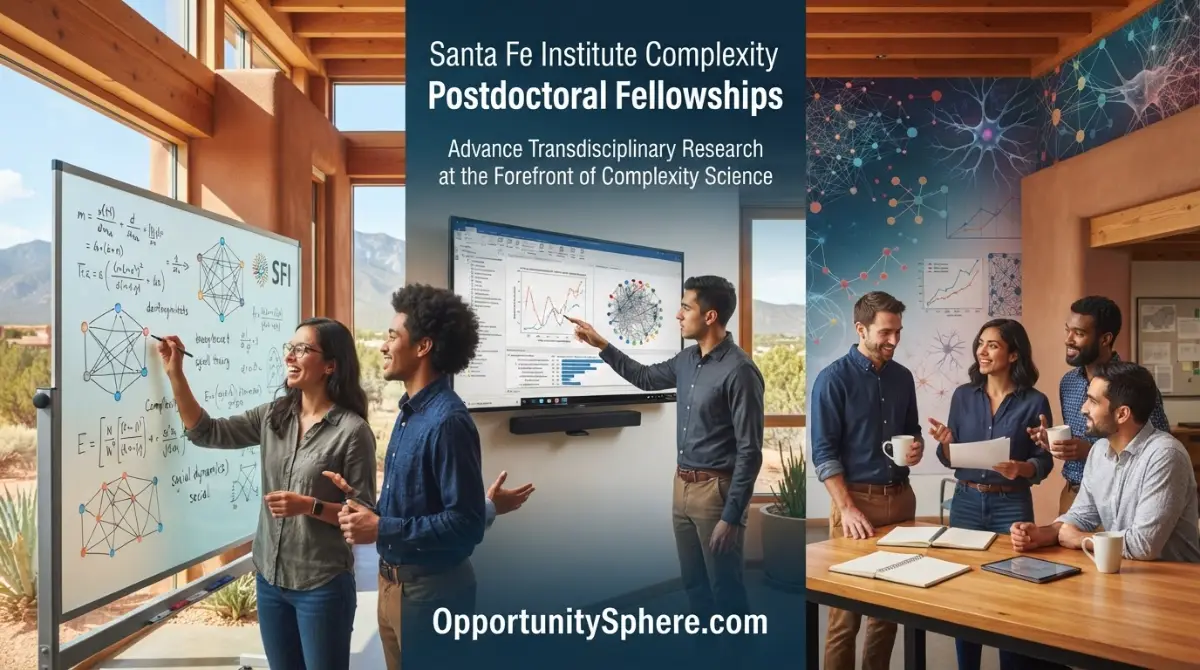
2027 Complexity Postdoctoral Fellowship – Santa Fe Institute
Offered by Santa Fe Institute
Location
United States
Funding
Fully Funded
Study level
Postdoctoral, Researchers
Field of study
Arts & Humanities, Mathematics & Statistics, Computer Science & IT, Physical Sciences, Social Sciences
Application deadline
September 30, 2026
Application Closed
About This Fellowship
The Santa Fe Institute (SFI) is inviting applications for its 2027 Complexity Postdoctoral Fellowships, also known as the Omidyar Fellowships. The fellowship is designed for outstanding early-career researchers who want to pursue innovative, interdisciplinary research on complex systems and questions that cross conventional academic boundaries.
The Santa Fe Institute is internationally recognized for its work on complexity science and for bringing researchers from different scientific disciplines together to investigate problems that cannot easily be addressed within a single academic field. The 2027 Complexity Postdoctoral Fellowship provides an opportunity for a recent PhD graduate to join this research community and develop an independent research agenda while collaborating with researchers from different disciplines.
Unlike a conventional postdoctoral position that may be closely tied to a specific laboratory or narrowly defined research project, the SFI Complexity Postdoctoral Fellowship offers substantial intellectual freedom. Fellows are encouraged to explore their own research interests and develop ideas that connect different areas of science.
The research environment at SFI is deliberately transdisciplinary. Researchers work across fields including mathematics, physics, biology, computer science, social sciences and the humanities. Research may be theoretical, computational or, in some cases, empirical. The Institute does not operate around traditional academic departments, allowing researchers to interact across disciplinary boundaries.
This makes the fellowship particularly suitable for researchers whose work does not fit neatly into a single conventional discipline. Applicants with strong quantitative and computational abilities may be particularly competitive, especially when they can demonstrate the ability to use ideas or methods from multiple fields to address important scientific questions.
The fellowship provides up to three years of residence at the Santa Fe Institute in Santa Fe, New Mexico. During this period, Fellows have the opportunity to develop their own research programmes, collaborate with resident and visiting researchers, participate in scientific activities and become part of the Institute's wider international research network.
Advertisement
🔒Application Closed
The listed deadline has passed. Check the official website to see whether the organisation has announced an extension or a new application period.
Stay in the loop
Your Next Opportunity Could Be One Email Away
Receive updates about scholarships, jobs, internships, fellowships and grants so you can discover opportunities worth exploring.
Stay Updated
Never miss an opportunity.
Get updates on scholarships, jobs, internships, grants, fellowships, conferences, and other opportunities delivered straight to your inbox.
The fellowship is intended for researchers at an early stage of their scientific careers. Applicants must have completed a PhD in a scientific discipline within six years of the application deadline, or expect to receive their PhD by September 2027.
The requirement for a scientific discipline is broad. SFI welcomes applications from candidates working in different scientific areas, provided they have strong quantitative skills and demonstrate an interest in multidisciplinary research. This means that the fellowship is not restricted to researchers formally trained in "complexity science."
The Institute is interested in researchers who can think beyond traditional disciplinary paradigms. Applicants should therefore demonstrate not only academic excellence but also intellectual curiosity, creativity and an ability to identify connections between apparently different areas of research.
The fellowship can be particularly valuable for researchers interested in complex adaptive systems, biological systems, evolution, artificial intelligence, networks, computation, social systems, collective behaviour, mathematical modelling, ecological systems or other areas where interactions between components produce complex outcomes.
The SFI research environment can also be useful for researchers who want to combine methods from different disciplines. For example, a researcher trained in biology might incorporate mathematical modelling or computational approaches into their work, while a computer scientist might explore biological, social or physical systems using computational methods.
The Institute describes its research as spanning the physical, natural and social sciences as well as the humanities. This broad intellectual environment gives Fellows opportunities to interact with researchers whose approaches may be very different from their own.
The fellowship also includes structured leadership development. Fellows participate in a programme designed to develop leadership skills during their residency and beyond. Activities can include sustained mentoring relationships, skill-development workshops, off-campus research and teaching experiences, and opportunities related to scholarly leadership and science management.
The programme therefore goes beyond providing salary and research support. It is designed to help early-career researchers develop into independent scientific leaders.
Fellows also receive discretionary research and collaboration funds. These funds can provide additional flexibility for developing research ideas, supporting collaborations and undertaking activities relevant to the Fellow's research.
The position includes a competitive salary and generous benefits, together with paid family leave. This makes it a substantial professional development opportunity rather than simply a short-term research placement.
International researchers are welcome to apply. U.S. citizenship is not required. However, successful international applicants must be legally able to work in the United States. The Santa Fe Institute states that it will sponsor a J-1 visa for successful candidates, while it cannot sponsor an H-1B visa for this fellowship.
Applicants should therefore consider their ability to obtain the appropriate U.S. work authorization when evaluating the opportunity.
The application requires several important components. Applicants must provide a curriculum vitae, including their publications list, as well as a research-interest statement of no more than two pages. The research statement should describe the research the applicant would like to pursue and explain the applicant's broader research interests.
Applicants must also provide a separate statement explaining their interest in the Santa Fe Institute. This statement should describe what the applicant could contribute to the SFI community and how participation in the Institute could influence or strengthen their research.
The Institute encourages applicants to think carefully about why an interdisciplinary environment would be particularly valuable for their work. Applicants may discuss the kinds of ideas or input they would like to obtain from other disciplines, potential multidisciplinary workshops they might organize, or aspects of their research that are difficult to pursue in a traditional academic environment.
Three recommendation letters are required. Applicants provide the names and email addresses of their recommenders, and SFI contacts the recommenders directly with instructions for submitting their letters.
Applicants may also optionally submit one paper or draft written in English that is relevant to their application.
Because the fellowship emphasizes intellectual independence, applicants should use their application to demonstrate what they want to investigate rather than simply describing their previous research. A strong application should make clear what questions the candidate finds important, why those questions require interdisciplinary approaches and how the SFI environment could help advance the proposed research.
The fellowship is especially appropriate for candidates who want to develop an independent research identity. Rather than being limited to a predefined project, Fellows have substantial freedom to explore questions that fit their interests and SFI's broader research environment.
The opportunity can also strengthen an early-career researcher's international network. SFI brings together resident faculty, postdoctoral fellows, external faculty and visiting researchers from different parts of the world. This creates opportunities for intellectual exchange and collaboration.
For researchers planning careers in academia, research institutes, computational science, interdisciplinary research or scientific leadership, the fellowship can provide valuable experience developing and communicating an independent research programme.
The fellowship also provides an opportunity to develop skills that extend beyond a particular research discipline. These include collaboration, interdisciplinary communication, scientific leadership, research planning, presentation, mentoring and scientific project development.
The 2027 application period opened on July 27, 2026 and closes on September 30, 2026. Applicants should complete all required components before the deadline because recommendation letters and other application materials must be coordinated in advance.
Eligibility:
Applicants must hold a PhD in a scientific discipline or expect to receive their PhD by September 2027.
The PhD must have been granted within six years of the September 30, 2026 application deadline.
Applicants should have an exemplary academic record.
Applicants should demonstrate strong computational and quantitative skills.
Applicants should demonstrate the ability to work independently.
Applicants should also demonstrate the ability to work collaboratively with researchers from different backgrounds.
Applicants should have a demonstrated interest in multidisciplinary or transdisciplinary research.
Applicants should demonstrate the ability to think beyond traditional disciplinary paradigms.
Applications are welcomed from candidates from any country.
Applicants may come from different scientific disciplines provided they have the required quantitative and interdisciplinary research strengths.
U.S. citizenship is not required.
Successful international candidates must be legally able to work in the United States.
The Santa Fe Institute states that it will sponsor a J-1 visa for successful international candidates.
The Institute does not sponsor H-1B visas for this fellowship.
Applicants must submit a curriculum vitae including their publication record.
Applicants must submit a research-interest statement of no more than two pages.
Applicants must submit a statement explaining their interest in the Santa Fe Institute, limited to one page.
Applicants must arrange three letters of recommendation from scholars familiar with their work.
Applicants may optionally submit one relevant paper or draft written in English.
Applicants must complete the online application before the September 30, 2026 deadline.
Benefits:
The fellowship provides a postdoctoral research position at the internationally recognized Santa Fe Institute.
Fellows can remain at SFI for up to three years.
Fellows receive a competitive salary.
Fellows receive generous employment benefits.
Paid family leave is included as part of the fellowship's benefits.
Fellows receive substantial intellectual freedom to develop their research interests.
Fellows can pursue interdisciplinary research across traditional academic boundaries.
Fellows receive discretionary research and collaboration funds.
Fellows can collaborate with researchers from mathematics, physics, biology, computer science, social sciences, humanities and other fields.
Fellows can work with leading researchers in complexity science.
Fellows can develop an independent research agenda.
Fellows receive opportunities for sustained mentoring from SFI resident and external faculty.
Fellows participate in structured leadership training.
Leadership development includes skill-development workshops and other professional-development activities.
Fellows can participate in off-campus research and teaching experiences.
Fellows can gain exposure to scholarly leadership and science-management opportunities.
The fellowship provides an opportunity to build an international scientific network.
Fellows can interact with visiting researchers and scientists from around the world.
The programme can help researchers develop interdisciplinary research skills.
Fellows can develop advanced quantitative and computational research abilities.
The fellowship can strengthen an early-career researcher's international academic profile.
The research environment can help candidates develop collaborations across conventional disciplinary boundaries.
Fellows can explore research questions that may be difficult to pursue within a traditional academic department.
The experience can strengthen future applications for academic positions and other research fellowships.
The fellowship can provide valuable preparation for independent research leadership.
Fellows become part of the broader Santa Fe Institute research community.
The opportunity can be particularly valuable for researchers interested in complex systems and interdisciplinary scientific problems.
International researchers can gain research experience within a major U.S. interdisciplinary research institute.
The fellowship can provide opportunities to develop collaborations that continue beyond the postdoctoral appointment.
The combination of research independence, mentorship, collaboration and leadership training makes the fellowship a strong early-career research-development opportunity.
Application Information:
Applicants should prepare their application well before the September 30, 2026 deadline because three recommendation letters are required.
The application should include a detailed academic CV with publications, a research-interest statement of no more than two pages, a one-page statement explaining the applicant's interest in SFI, and three recommendation letters. An optional relevant paper or draft may also be submitted.
Applicants should make their research statements specific rather than simply describing their previous doctoral research. The application should demonstrate intellectual independence and explain how the applicant's research could benefit from the highly interdisciplinary environment at SFI.
Candidates should also explain why their research would contribute to the SFI community and what they hope to gain from interacting with researchers outside their own discipline.
International applicants should pay particular attention to the Institute's work-authorization requirements. While citizenship of the United States is not required, successful international candidates must be legally able to work in the United States, and SFI states that it will sponsor a J-1 visa for successful candidates.
Applications for the 2027 Complexity Postdoctoral Fellowships are accepted from July 27 through September 30, 2026.
Related Opportunities
Explore other scholarships, fellowships, grants, research opportunities and more that may match your interests.