The application deadline for this opportunity has passed. You can still review the details, but the listing is no longer presented as open for applications.
Conference
European Winter School for Women in the Study of Work and Employment Relations 2027
Offered by Institute Labour and Economy (iaw), University of Bremen
Location
Bremen, Germany
Funding
Fully Funded
Study level
PhD, Researchers
Field of study
Development Studies, Political Science, Economics, Social Sciences
Application deadline
October 15, 2026
Application Closed
About This Conference
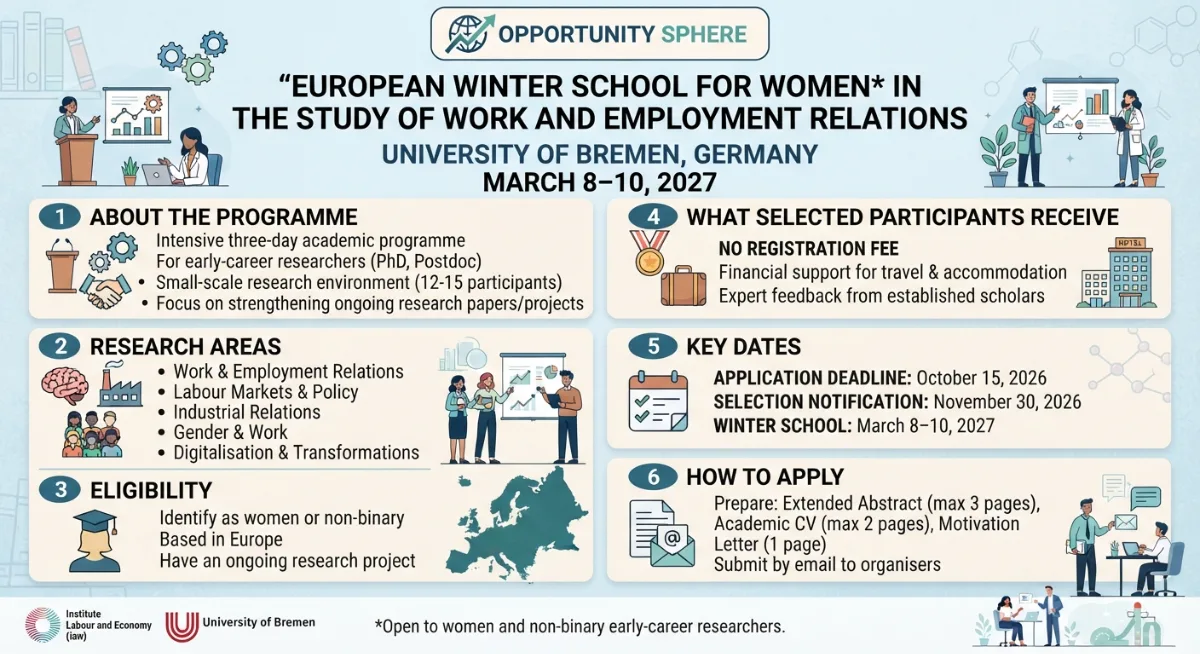
The European Winter School for Women* in the Study of Work and Employment Relations is an intensive three-day academic programme for early-career researchers investigating contemporary questions around work, employment, labour markets, organisations and employment relations.
The 2027 edition will be organised by the Institute Labour and Economy (iaw) at the University of Bremen, Germany, and is designed as a small-scale research environment rather than a conventional academic conference. Only 12–15 researchers will be selected, allowing participants to work closely with established scholars and other researchers at a similar stage of their academic careers.
A central purpose of the Winter School is to give participants dedicated time and expert feedback to strengthen an ongoing research paper or project. The programme also addresses broader aspects of an academic career, including research funding, publication and career development. Discussions are expected to connect different disciplinary perspectives on how employment systems, workplaces and labour markets are changing.
The Winter School brings together researchers from across Europe and related academic disciplines, creating an environment where participants can compare different theoretical approaches, research methods and institutional perspectives. The programme also includes engagement with social partners, helping participants consider how research on work and employment relates to organisations and actors outside academia.
The 2027 event will take place from March 8–10, 2027, at the University of Bremen.
Research Areas
The Winter School is particularly relevant to research addressing questions such as:
Work and employment relations
Labour markets and employment policy
Industrial relations
Trade unions and collective bargaining
Workplace organisation and employment practices
Employment institutions and regulation
Sociology of work
Political economy of employment
Labour and social policy
Advertisement
🔒Application Closed
The listed deadline has passed. Check the official website to see whether the organisation has announced an extension or a new application period.
Stay in the loop
Your Next Opportunity Could Be One Email Away
Receive updates about scholarships, jobs, internships, fellowships and grants so you can discover opportunities worth exploring.
Stay Updated
Never miss an opportunity.
Get updates on scholarships, jobs, internships, grants, fellowships, conferences, and other opportunities delivered straight to your inbox.
Digitalisation and transformations in the workplace
Other closely related areas of labour and employment research
Researchers working in neighbouring disciplines such as sociology, political science, economics, gender studies, psychology or European studies may also be suitable where their research has a substantive connection to work and employment relations.
Eligibility
The Winter School is aimed at early-career researchers who identify as women or non-binary and are based in Europe.
Applicants may include:
Doctoral researchers conducting research related to work and employment relations.
Postdoctoral researchers who completed their PhD within the last five years.
Early-career researchers from relevant social-science and interdisciplinary fields whose research addresses employment, labour, organisations or related questions.
Applicants should have an ongoing research project or paper that would benefit from the intensive discussion and feedback offered by the Winter School.
Because places are limited, applicants should demonstrate a clear connection between their research and the theme of the programme rather than submitting a general academic profile without a relevant research project.
What Selected Participants Receive
Selected participants will not pay a registration fee for the Winter School.
The organisers also provide financial support for participants who do not have sufficient funding from their home institution. This support can cover eligible:
Travel expenses to and from Bremen.
Accommodation expenses during the Winter School.
Applicants who require financial assistance should explain their circumstances in the motivation letter and provide an estimate of their expected travel and accommodation costs.
Participants should also indicate whether their university, research institute or another funding source can contribute to the costs.
Academic Programme
The Winter School combines research discussion with professional and career development. The 2027 programme includes:
Research and paper workshops
Participants will present and discuss their research and receive feedback intended to help them develop their work further.
Keynote and academic sessions
Established researchers will contribute to discussions on current developments and debates in the study of work and employment relations.
Research funding discussions
Sessions will address research grants and the practical challenges involved in developing and funding an academic research career.
Academic career discussions
Participants can exchange experiences and perspectives on academic career development and the early stages of an academic career.
Interaction with social partners
The programme includes engagement with representatives of social partners, providing a perspective on how research connects with institutions and organisations involved in the world of work.
Peer exchange
The small cohort allows participants to discuss their research with researchers working on different but related questions across European academic systems.
Confirmed Academic Participants
The 2027 programme brings together researchers connected with institutions including:
University of Bologna
University of Bremen
WZB Berlin Social Science Center
Hans-Böckler-Stiftung / WSI
London School of Economics and Political Science
KU Leuven
Confirmed contributors include Chiara Benassi, Irene Dingeldey, Lena Hipp, Bettina Kohlrausch, Ania Plomien and Valeria Pulignano, among others.
The range of participating scholars reflects the interdisciplinary nature of the Winter School, covering different perspectives on labour markets, employment relations, organisations, inequality and working life.
Application Requirements
Applications should be submitted in English and should include:
Extended Abstract
Maximum three pages.
Should present the research paper or project the applicant intends to develop during the Winter School.
Academic CV
Maximum two pages.
Should summarise the applicant's academic background, research experience, publications and other relevant academic activities.
Motivation Letter
One page.
Should explain the applicant's interest in the Winter School, the relevance of the programme to their research and what they hope to gain from participating.
Financial Information
Applicants requesting financial support should explain their funding situation.
Estimated travel and accommodation costs should also be provided.
Preparing the Extended Abstract
The extended abstract should give the selection team a clear understanding of the research the applicant would bring to the Winter School.
Where applicable, applicants should address:
The central research question or problem.
The theoretical or conceptual framework.
Existing literature or debate to which the research responds.
Research data, materials or sources.
Methodology and analytical approach.
Main findings or expected findings.
The contribution the research aims to make.
Questions or aspects of the project for which feedback would be particularly valuable.
Applicants do not need to describe their entire doctoral thesis if a more focused paper or research component can generate a stronger academic discussion.
Important Financial Information
Financial assistance is intended for selected participants who do not have sufficient institutional funding.
Applicants should therefore establish whether their university, research institute, doctoral programme or other funding source can contribute towards participation before requesting support from the Winter School.
Those seeking support from the organisers should clearly state their financial circumstances and provide realistic estimates of travel and accommodation costs.
Selection Process
The Winter School has a deliberately small cohort of approximately 12–15 participants.
Selection is therefore based not simply on academic seniority but on the relevance and quality of the proposed research, the applicant's motivation and the potential for meaningful exchange within the programme.
Applicants should make their research connection to work and employment relations clear and explain why participation at this particular stage of their research would be valuable.
Important Dates
Application deadline: October 15, 2026
Selection notification: November 30, 2026
Full paper draft deadline: January 15, 2027
Winter School: March 8–10, 2027
Venue: University of Bremen, Germany
Selected participants are expected to submit a full paper draft by January 15, 2027. This allows the research to be circulated and discussed during the Winter School rather than limiting participation to a short presentation.
How to Apply
Applicants should prepare the three required academic documents in English:
Extended abstract of no more than three pages.
Academic CV of no more than two pages.
Motivation letter of one page.
Applicants who require financial assistance should also include their funding situation and estimated travel and accommodation costs.
The complete application should be submitted by email to the organisers before October 15, 2026.
Why This Opportunity May Be Useful
The Winter School is particularly relevant for researchers who are developing a paper, dissertation chapter or research project and would benefit from intensive academic feedback before taking the work to publication or a larger research audience.
Its small cohort also distinguishes it from large academic conferences. Instead of attending a programme with hundreds of participants, selected researchers work within a focused group and have opportunities for sustained discussion with senior scholars and peers.
The combination of research development, grant-related discussions, academic career sessions and interaction with social partners makes the programme useful not only for improving an individual research project but also for understanding different dimensions of an academic career in the study of work and employment relations.
Related Opportunities
Explore other scholarships, fellowships, grants, research opportunities and more that may match your interests.